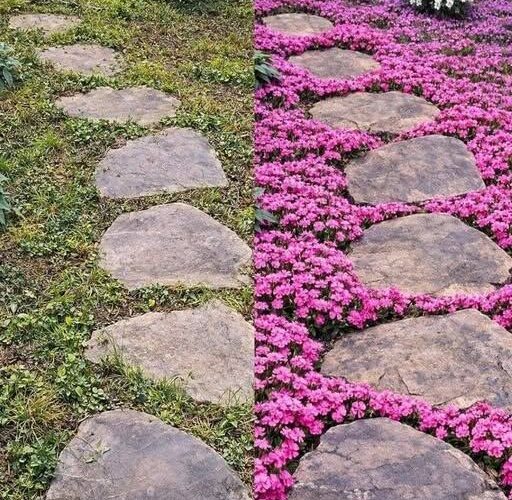
Dense ground cover plants act as a natural living mulch that blocks sunlight and keeps weed seeds from sprouting.
Geranium macrorrhizum: The absolute champion in weed control. It has dense, aromatic leaves, can handle full sun and dry shade, and quickly forms an impenetrable carpet.
Periwinkle (Vinca minor): An evergreen perennial with glossy leaves and purple flowers. It roots at the nodes, quickly taking over an area in both sun and deep shade.
Climbing ivy (Hedera helix): An uncompromising solution for difficult, dark corners of the garden. Once it grows along the ground, weeds lose any chance of survival.
Thyme (Thymus serpyllum): A great choice for dry, sunny spots and between stepping stones. It forms a dense, fragrant cushion and can withstand light trampling.
Creeping thyme (Ajuga reptans): It spreads quickly by the air and forms dense rosettes of leaves. It blooms in May with blue spikes and does best in partial shade.
Pachysandra terminalis: An evergreen perennial for partial shade and shade. It forms an even, robust and elegant growth that nothing can grow through.
Cotoneaster dammeri: A low, evergreen shrub, perfect for slopes and large areas. Its dense, woody branches and shiny leaves will suppress and smother weeds.
Waldsteinia ternata: It resembles wild strawberries in appearance, but forms an impermeable carpet with yellow flowers. It is extremely hardy.
Sedum spurium: A hardy succulent for extremely dry and sunny sites. It quickly covers rocky or poor soil with a continuous layer.
Lamium maculatum: A fast-growing perennial for partial shade. Silver-green leaves brighten dark corners and quickly occupy every free centimeter.
Poscharsky’s bellflower (Campanula poscharskyana): An energetically expansive perennial that blooms in summer with a flood of purple flowers and creates a continuous green barrier.