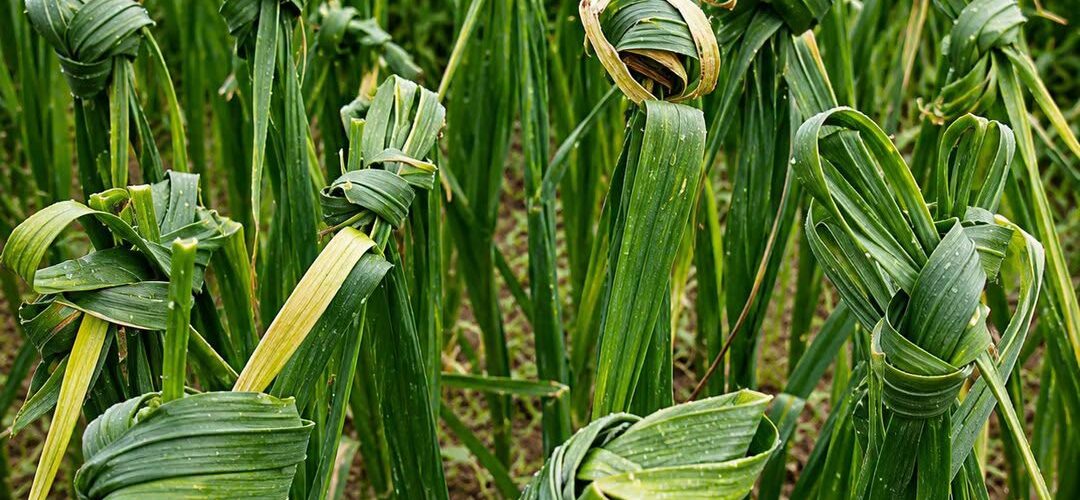
Tying or knotting garlic leaves is an old gardening trick that is used primarily in Eastern Europe and in traditional vegetable growing. Even if it looks bizarre at first, there is a logical plant physiology behind it.
Here is the secret behind the “amazing effect”:
The biological trick: energy redirection
When the garlic is fully grown in early summer (usually a few weeks before harvest), the plant puts a lot of energy into growing new leaves, pseudo-stems or forming flowers/bulbs.
By tying the foliage in a knot, the following happens:
Stopping the growth of the foliage: The knot slightly injures the conductive pathways of the leaves and signals the plant to stop the growth of the above-ground greenery.
Focus on the bulb: Since energy can no longer flow into new leaves, the plant radically redirects all remaining nutrients and juices downward – directly into the garlic cloves.
The result: The garlic bulbs become significantly larger, plumper and ultimately store better because they are fully ripe.
When and how do you do that?
To get the most out of the effect, it’s all about the right timing:
The timing: The knot is tied about 2 to 3 weeks before the planned harvest (usually in June or July, depending on the variety). At this point, the lower leaves usually begin to turn slightly yellow.
The technique: Take all of the top foliage of a plant and gently but firmly tie it into a simple knot. If the foliage is very stiff, bend the leaves slightly beforehand.
Additional tip (important!): If your garlic sprouts flower stalks (scapes), you should cut them off or break them out beforehand anyway. The formation of flowers robs the tuber of most of its strength. (By the way, the garlic stalks are delicious in the pan!).
Is it really worth it?
Logically, this is not done in modern, large-scale agriculture – the workload would be far too high. But it’s a great experiment in your own garden or raised bed. Many gardeners swear that knotting makes the tubers up to 20-30% larger than their untreated neighbors.
Have you already tried this trick on a few test plants or are you planning to use it for the next harvest?