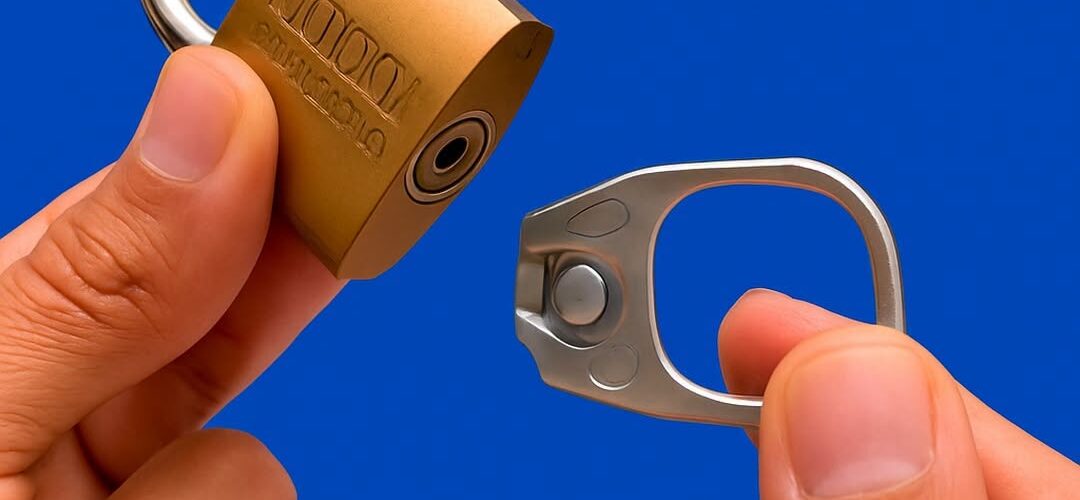
This sounds like the ultimate insider tip or a brilliant party trick – and the titles of clickbait books on the internet often promise that you can open any door in two seconds with a paperclip or a soda can, just like a master thief in the movies.
However, the reality behind the “magic” of lock picking (in technical terms, lockpicking) is less about sorcery and more about pure physics, fine motor skills, and a whole lot of patience.
Here’s an uncensored look at how it all really works, why some tricks work – and where the limits lie.
The physics behind the lock: Why locks open at all
Most classic locks (e.g., on front doors or padlocks) are pin tumbler locks. Inside are small, split metal pins that are pushed down by springs. They block the cylinder, preventing it from turning.
The correct key has teeth or notches that push these pins upwards precisely so that the pin dividing line lies exactly on the edge of the cylinder (the so-called shear line). Only then can the cylinder be turned.
The 3 most well-known methods (and the truth behind them)
- Classic lock picking (tensioning hook & tension wrench)
This is the method you know from movies. You use two tools: a tension wrench, which holds the cylinder slightly rotating, and a pick (hook), which is used to push the pins upwards one by one.
The effect: The slight rotation of the tension wrench causes the pins to tilt slightly. When you push a pin to the correct height, it “sticks” in the up position. Once you’ve caught all the pins, the lock turns.
The reality: This doesn’t happen “in the blink of an eye” unless you’ve practiced for months on test cylinders. It requires extreme dexterity. Modern locks often have fake pins (dumbbell pins) installed, which deliberately mislead lock pickers.
- The “Bypass” Methods (The Coke Can Method)
Especially with inexpensive padlocks (e.g., for lockers or cellar doors), you often see the trick of cutting a small “U” shape out of an aluminum can and inserting it into the gap of the shackle (a so-called shim).
The effect: The metal simply pushes back the spring mechanism that blocks the shackle, without having to touch the pins in the cylinder at all.
The reality: This actually works surprisingly often – but only with very cheap padlocks. High-quality locks have a ball-bearing locking mechanism, where this trick is physically impossible.
- The Bump Key
A specially filed key where all the teeth are in the lowest position. It is inserted into the lock and then struck with a light tap (e.g., with a plastic hammer).
The effect: The principle is similar to billiards: The tap transfers energy to the pins, which spring upwards for a fraction of a second, releasing the shear line. At that moment, the key is turned.
The reality: This method is extremely effective and opens many standard cylinders very quickly. This is precisely why modern, higher-quality lock cylinders are now equipped with bump protection (anti-bump features) as standard.
Conclusion: Who is the real magician?
The real “magic” of keyless entry is primarily mastered by locksmiths – and these days they usually exploit entirely different vulnerabilities: They don’t attack the lock itself, but rather the door latch (e.g., with a thin plastic card or a wire loop through the peephole), because the door is often only pulled shut and not locked.
Lockpicking as a hobby (sports smashing) enjoys worldwide popularity, but it requires discipline and legal protection:
⚠️ The golden rule of lockpicking is: Never pick a lock that doesn’t belong to you or that you rely on in your daily life (as the pins can easily be damaged).
If you want to learn the art yourself, it’s best to get a set online with a transparent acrylic practice lock. This way you can see exactly what the pins do – and the “aha!” moment is guaranteed!