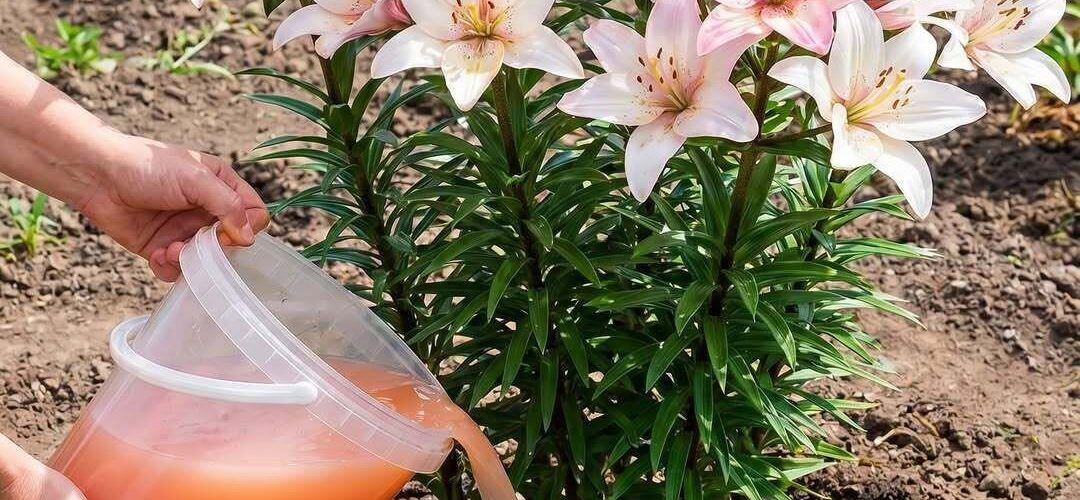
June is the crucial month for lilies: Many varieties are now opening their buds or are just about to burst into bloom. To ensure the flowers are particularly large, intensely colored, and plentiful, you need to provide the plants with the perfect balance of nutrients, water, and protection right now.
Lilies follow an old gardener’s adage: “Head in the sun, feet in the shade.” Following this principle in June will lay the foundation for a true floral spectacle.
The four most important care steps in June at a glance:
- Nutrient Boost for Bud Formation (Early June)
As soon as the first flower buds appear, the bulb consumes a tremendous amount of energy. Now is the perfect time for the final, crucial fertilization before flowering.
Lilies follow an old gardener’s rule: “Head in the sun, feet in the shade.” If you follow this principle in June, you’ll lay the foundation for a true explosion of blooms. The right fertilizer: Use a potassium-rich fertilizer (e.g., liquid tomato fertilizer or special bulb fertilizer). Potassium strengthens the tissue and ensures vibrant colors and large blooms.
What to avoid: Don’t use purely nitrogen-rich fertilizers now (such as horn meal or pure nettle manure). Too much nitrogen in June makes the stems soft and susceptible to disease and wind damage.
- Watering correctly: Deep watering instead of shallow watering
In June, it can get very hot and dry at times. Lilies hate prolonged drought during the bud stage, but they are equally sensitive to waterlogging.
The method: Water thoroughly once or twice a week, rather than just a little every day. The water needs to penetrate deep into the bulbs (about 20 cm deep).
The pro tip for cool roots: Since lily roots don’t like heat, you should shade the soil around the stems. This works wonderfully with a layer of bark mulch, grass clippings, or by planting low-growing companion plants (such as geraniums or ground cover perennials) in front of them.
- The Lily Beetle Check (Daily Inspection)
June is peak season for the lily’s greatest enemy: the lily beetle. This bright red beetle and its voracious larvae can completely defoliate buds and leaves within just a few days.
Remedy: Check the plants, ideally in the morning. Consistently collect the red beetles. Also, look under the leaves: If you discover brownish, slimy clumps (the larvae), wipe them off with a cloth or spray the plant with a strong jet of water.
- Support and Remove Faded Blooms
Some lily varieties (such as the majestic tree lilies or oriental lilies) grow well over a meter tall. The heavy flower heads quickly cause the stems to bend or break in June.
“` Support: Place an inconspicuous bamboo or wooden stake next to the stem in good time and tie it loosely with raffia.
During flowering: Immediately remove any faded blooms. This prevents the plant from putting energy into seed production and instead directs its power into the still-closed buds.
Important for cutting: If you want to cut lilies for a vase, cut the stem no more than halfway down. The remaining green leaves are essential for the bulb to gather energy for the following year through photosynthesis.