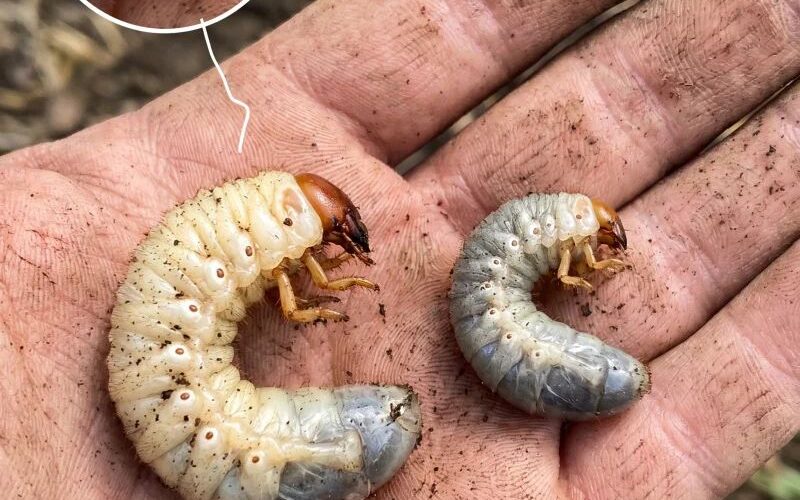
Almost every gardener who starts digging or composting in spring and autumn is familiar with this problem. The sight of these “pests” feeding on the roots of all plants often leads to quick (and mistaken) intervention.
However, there is a fundamental difference between a pest (beetle) and a beneficial insect (goldfinch), which can even be seen with the naked eye.
Quick identification chart: Larvae under a magnifying glass
Signs: Beetle larva (pest) Goldfinch larva (beneficial)
Habitat: In flower beds, under the lawn, near roots. In compost, in rotting leaves, in mulch.
Head: Large, distinctly brown and thick. Small, with a lighter head in proportion to the body.
Legs: Long, visible, strong. Very short, almost imperceptible.
Abdomen: Narrow, tapering to a point. “Thick,” swollen, and rounded.
Ingenious movement test: “Running in a straight line”
If you are unsure of its appearance, place the larva on a smooth surface (e.g., a tile or a shovel) and observe how it tries to escape:
The goldfinch larva rolls onto its back: Paradoxically, but usefully, the goldfinch larva moves on its back using undulating body movements. It doesn’t use its legs at all. If you see the larva “swimming” on its back, leave it alone. In compost, it serves as a source of fertilizer.
The beetle tries to crawl on its legs: The beetle larva tries to use its long legs and crawls on its side or belly. If it tries to “walk,” it is the enemy of your seedlings and lawn.
Why is this important?
Goldfinch (beneficial insect): It feeds exclusively on dead organic material. In compost, it accelerates decomposition, much like earthworms. If you find one in a flower bed, you’ve probably accidentally introduced it there with the compost – it’s not interested in the roots of your plants. Beetle (pest): The larvae of the common beetle spend 3 to 4 years in the soil, actively feeding on the roots of vegetables, strawberries, and young trees. A single larva can destroy an entire seedling.
How can you be kind to wildlife?
If you find goldfinches in your compost, simply leave them there – they are your best helpers. If you find beetles in your flower beds, the most environmentally friendly approach is to collect them by hand and feed them to birds or chickens, which will happily eat them.
Do you already have this “living army” in your compost, or have you been rather afraid of them so far?