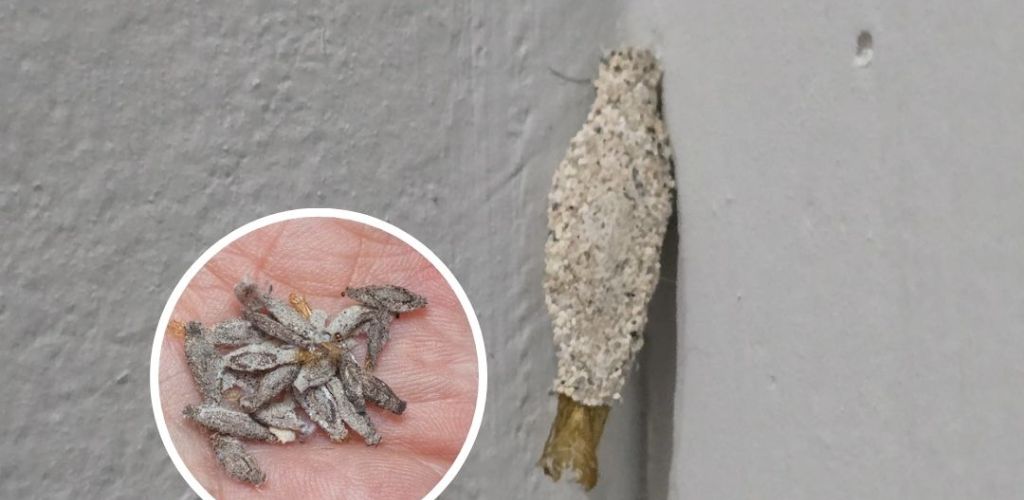
That’s absolutely right! You’re talking about the Kamitetep, also known as the Plaster Bagworm.
This insect often causes confusion or mild unease when you first see it on a wall or ceiling.
🐛 What is the Kamitetep (Phereoeca uterella)?
The Kamitetep is actually the larva of a moth species (Phereoeca uterella, from the family Tineidae).
Its most striking feature is the protective case it makes itself and carries with it everywhere.
Characteristic Description
Appearance The case is flat, grayish-brown, and often resembles a small pumpkin seed or a flattened almond (approx. 10–15 mm long).
Construction: The larva spins a silken sac and cleverly camouflages it with materials from the environment, such as sand particles, dust, fibers, hair, or pieces of plaster.
Movement: It can be seen slowly crawling up walls or ceilings, with the larva extending its head and front pair of legs from one of the two openings of the sac to move around.
Diet: Contrary to its name, the “plaster sac worm” feeds primarily on cobwebs, dust, hair, dead insects, and sometimes natural fibers (wool, silk). It is therefore more of a cleanup operator and a material pest.
The Kamitetep is widespread in many tropical and subtropical regions but can also be found in warmer regions or heated houses worldwide. It prefers damp, quiet, and dusty places (cellars, attics, closets).
Have you recently discovered this fascinating insect yourself?