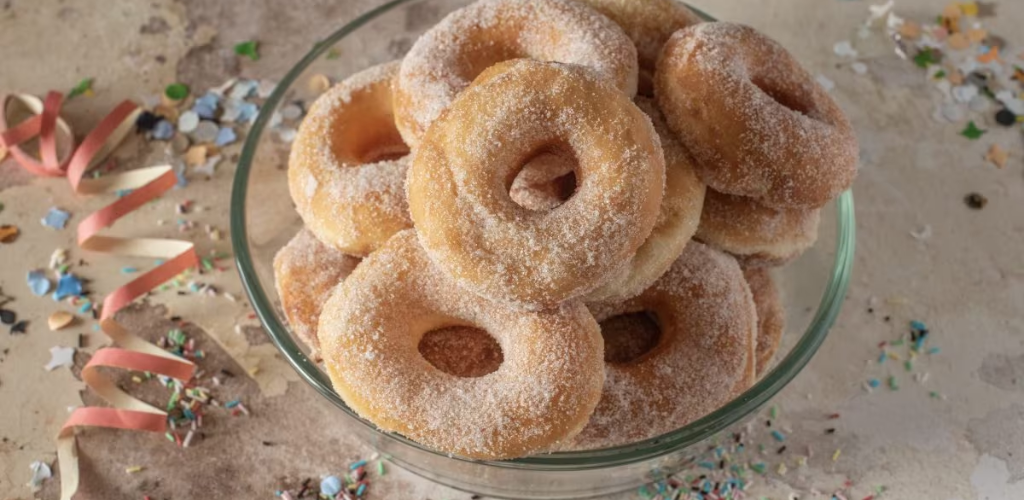
Graffe are soft donuts , fried and covered in sugar, typical of Neapolitan pastry , made with a dough based on potatoes , flour , yeast and butter , which is very soft thanks to the addition of boiled potatoes and double leavening .
It is a leavened dessert which in Naples is traditionally prepared at Carnival together with other typical specialties, such as the ” mileccio ” or potato zeppole , similar in the dough but distinguished by the “elle” shape, which can be enjoyed all year round. because it is easily found in Neapolitan pastry shops.
Graffe are a delicacy of ancient origin, a reworking of German krapfen – small fried dough filled with jam – which arrived in Campania at the beginning of the eighteenth century, during the period of Austrian domination: therefore a traditional recipe, which however has numerous variations regional and non-regional. Among the most common are the staples without potatoes , those baked , those filled with cream and black cherry and the delicious version with chocolate chips .
The preparation of the staples is really simple, even if we advise you to make them when you have some time available because it will take about 3 hours for the double leavening, an essential step to obtain a puffy and soft dough. After having prepared the dough, which can be worked by hand or with the planetary mixer , and having waited for the leavening times, it must be rolled out with a rolling pin and obtained into the donuts, using a pastry ring, special molds or your hands, simply making a cylinder which will then be closed in the shape of a bow.
To have very soft staples that melt in your mouth, just like the oldest Neapolitan pastry shops prepare them, we give you some preliminary suggestions. First of all, avoid watery potatoes such as new potatoes and use floury potatoes , with yellow or white flesh, which will allow you to obtain a soft dessert with clearly visible honeycombs.
If you want to prepare Neapolitan graffe in winter, when temperatures are lower, use the oven to help leavening: turn it on for a few minutes, let it heat up, turn it off, place the dough in a covered bowl with a cloth and put it in the oven, leaving only the light on; a temperature of around 30°C will be created, ideal for allowing the dough to rise to perfection.
Finally, to make perfect and non-greasy frying, follow these two suggestions: cut a sheet of parchment paper into squares and arrange the donuts on each of them before the second leavening. When the staples are ready to be dipped in boiling oil, you can slide them into the pan directly with the parchment paper, avoiding touching and crushing them with your fingers. Finally, equip yourself with a good cooking thermometer , useful for monitoring the temperature of the oil which must always be high and constant, around 160 °C .
Find out how to prepare soft Neapolitan staples by following our procedure with tips and tricks.
If you like this recipe, try donuts , the typical American donuts.
Ingredients
FOR THE YEAST
LATTE
5 tbsp
TYPE 00 FLOUR
2 tbsp
FRESH BREWER’S YEAST
10 gr
FOR THE DOUGH
MANITOBA FLOUR
300 gr
TYPE 00 FLOUR
125 gr
POTATOES
250 gr (yes raw)
BUTTER
50 gr
BLOOD ORANGE JUICE
50 ml
EGG
2
SUGAR
1 tablespoon
SALE
1 Teaspoon
FOR FRYING AND DECORATING
PEANUT OIL
q.b.
CASTER SUGAR
q.b.
How to prepare Neapolitan graffe
With our recipe you will get about 20 medium-large staples or 28 small staples. Here’s how to prepare them soft and perfectly honeycombed starting from the dough.
How to prepare the soft staple dough
For the preparation of the graffe dough, if you don’t have fresh brewer’s yeast available, you can replace it with 7 g of dry brewer’s yeast. Furthermore, we have used a mix of 00 flour and manitoba flour, a flour that is defined as “strong” and ideal for doughs that require a long leavening.
Step 1
To prepare the Neapolitan graffe, start with the dough and take the potatoes: peel them and put them in a saucepan with cold water (1). Transfer them to the stove and boil them until they are soft and easy to pierce with the tines of a fork: this will take from 40 minutes to 1 hour, depending on the size of the tubers. Once cooked, drain them, mash them and let them cool.
Step 2
In the meantime, make the yeast. In a small bowl, dissolve the yeast in the warm milk
2
, add a couple of tablespoons of flour taken from the total, and let the mixture rest for about 30 minutes.
Step 3
After the indicated time, combine the flours, the warm potato puree and the yeast in a bowl. Also add the cubed butter and the eggs
3
.
Step 4
Also pour in the orange juice
4
and start mixing the mixture.
Step 5
Work the dough with your hands and, when it has become compact, transfer it to a floured work surface. Keep kneading until you get a firm and homogeneous dough
5
.
Step 6
Put the stick in a bowl, cover it with a kitchen towel
6
and let it rise for about 2 hours, until the initial volume has doubled. The ideal temperature for leavening is 26-30 °C. To facilitate the leavening process, you can cover the bowl with a wool cover or place it in the oven, heated for 10 minutes, turned off and left with the light on.
How to form staples to perfection
To easily give the dough the shape of the staples, we recommend flouring the work surface and the rolling pin and using pastry rings of two different sizes, one larger and the other smaller. If you don’t have them available you can use your hands, form cylinders and give them the shape of a bow.
Step 7
After the first leavening you can form your staples by spreading the dough to about 1 cm thick with a rolling pin and, using the special moulds, obtaining donuts
7
: use a larger 9 cm pastry cutter and a smaller 3-4 cm one. Knead the scraps again and shape more donuts until you run out of dough.
Step 8
Arrange each donut on a square of parchment paper and let rise for about 1 hour, covering with transparent film
8
.
How to fry Neapolitan graffe without grease
For frying staples we suggest you choose peanut oil: characterized by a smoke point exceeding 200°C, it is among the oils that least alter the taste of food. Finally, equip yourself with a cooking thermometer, essential for monitoring the temperature of the oil.
Step 9
Once the second leavening is finished, proceed with the frying of the staples. Heat plenty of oil in a pan, dip the donuts with all the parchment paper and then remove it with the help of pliers
9
. Make sure the oil temperature is constant, around 160°C – you can monitor the temperature of the oil using a cooking thermometer. To keep it constant, fry up to 3 donuts at a time.
Step 10
When the donuts are well browned, turn them upside down and continue cooking on the other side as well
10
.
Step 11
Once well puffed and golden, drain the donuts, place them on absorbent paper to remove the excess oil and immediately roll them in the sugar
eleven
.
Step 12
Arrange the donuts on a serving plate and serve piping hot: the Neapolitan staples are ready to be enjoyed
12
.
Tips and variations
To give the staples more fragrance, you can also add the grated rind of an orange or lemon , a pinch of vanilla powder or a mix of the three, to be macerated for a few hours in rum , brandy or orange juice . You can also flavor couverture sugar with ground cinnamon or vanilla.
You can also prepare graffe without potatoes , following the recipe for the classic fried donuts. For a lighter cooking, you can also bake the donuts in a preheated oven at 180°C for 25 minutes .
If you don’t have pastry cutters of 9 and 3 cm in diameter, you can make staples by hand: make loaves from the dough, form loaves and close them to obtain bows or fold them over, weave them and close them to have donuts intertwined. If you want to prepare lactose-free staples, you can use lactose-free milk and butter.
storage
Neapolitan graffe are perfect to be enjoyed hot, fried on the spot. However, they keep soft at room temperature for up to 3 days in an airtight container. If you prefer, you can also reheat them for a few minutes in the oven before serving.
Why are braces called that?
The Neapolitan staples are thus called from the Lombard krapfo , ” hook “, in reference to the initial shape of the donuts.
These German sweets spread in Naples in the eighteenth century, during the Austrian domination, thanks to the Monzù, the court cooks, and were adapted by the Neapolitan people, who added mashed boiled potatoes to the dough.