Ingredients
CHICKPEA FLOUR
200 gr
WATER
600 ml
SALE
1 Teaspoon
CHOPPED FRESH PARSLEY
q.b
PEANUT OIL (FOR FRYING)
500 ml
SICILIAN MAFALDE
6-7
LEMON
1
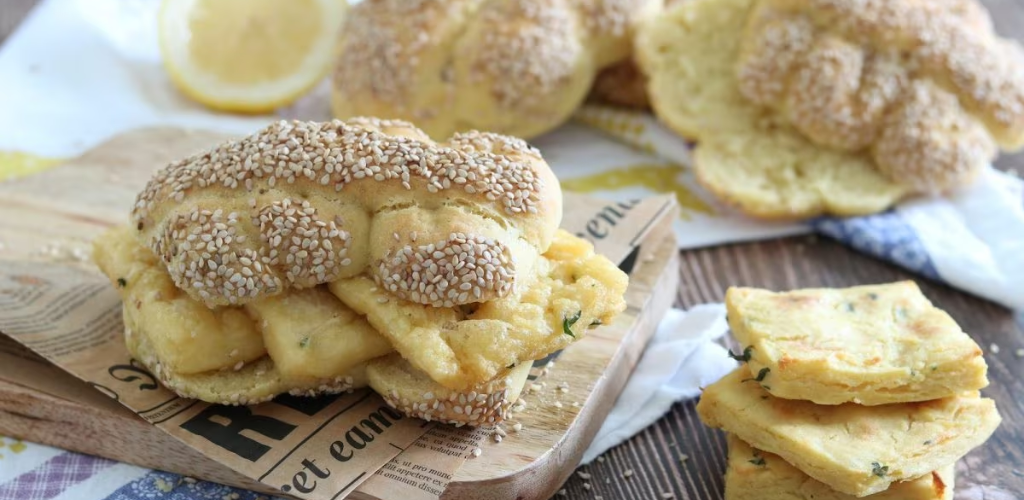
Panelle are pancakes made with chickpea flour, water, parsley and salt . A great classic of Palermo street food , they are usually served piping hot inside mafalde , a typical bread covered with sesame seeds, with the addition of lemon juice and a pinch of salt. Crispy on the outside and soft on the inside, they are fried in boiling seed oil and are a temptation that is impossible to resist. Making panelle at home is very simple and, once ready, you can enjoy them together with cold cuts and cheeses as an appetizer or for a delicious aperitif, also suitable for those who follow a vegan and gluten-free diet.
For the success of the recipe, it is necessary to follow a few easy indications: first of all, carefully sift the chickpea flour , to avoid the formation of lumps; always to obtain a smooth and creamy mixture, it is important to pour the water a little at a time, stirring constantly with a whisk, and then move the mixture into a saucepan and cook until it thickens. At the end, parsley is added for a fresh and fragrant note.
It is also important to pay attention to the proportion of ingredients: the original recipe, in fact, requires the amount of water to be three times that of chickpea flour. The panelle must have a thickness of about 5 mm and, to spread them, we can help ourselves with a smooth spatula. Once cooled, they are cut with a knife or pastry cutter to obtain more regular rectangles. Tradition has it that the panelle are fried without ever being turned, but for a lighter version it is possible to cook them in the oven .
Find out how to prepare them by following the step-by-step procedure and advice. Also try the cazzilli from Palermo and the sfincione from Palermo .
How to prepare panelle
Step 1
Sift the chickpea flour
1
.
Step 2
Place the sifted chickpea flour in a large bowl
2
.
Step 3
Start pouring the water, stirring with a whisk
3
.
Step 4
As you add the water, mix carefully with a whisk to avoid the formation of lumps
4
.
Step 5
Pour in all the water and, when finished, the dough should have a very liquid consistency
5
.
Step 6
Add the salt
6
and mix with a whisk.
Step 7
Pour the panelle dough into a saucepan
7
.
Step 8
Transfer the pot to the low heat and whisk continuously
8
.
Step 9
The compound slowly begins to thicken
9
.
Step 10
Start mixing with a wooden paddle
10
.
Step 11
Gradually it will begin to detach from the walls
eleven
.
Step 12
Add the chopped parsley
12
.
Step 13
Stir again for a couple of minutes until it starts to simmer
13
.
Step 14
Remove from the heat and pour the panelle dough onto a sheet of parchment paper. Level with a smooth spatula to evenly distribute the compound which must have a thickness of about 5 mm
14
.
Step 15
Let cool to room temperature
15
.
Step 16
Cut out the panelle with a pastry cutter or a rectangular cookie cutter
16
.
Step 17
Gently peel the panels off the parchment paper
17
.
Step 18
The panelle must be compact, without lumps and 5 mm thick
18
.
Step 19
Fry the panelle in boiling oil for about 2 minutes without turning them
19
.
Step 20
Drain the panelle with a perforated spatula
20
.
Step 21
Arrange the panels on a plate with absorbent kitchen paper
21
.
Step 22
For the baked version, instead, arrange the panelle on the pan, lined with parchment paper
22
. Cook at 200 °C for about 15 minutes and for another 2 minutes with the grill function.
Step 23
Bake the panelle
23
.
Step 24
The fried and baked panelle are ready to be enjoyed
24
.
Step 25
Cut a crunchy and fragrant Sicilian mafalda in half lengthwise
25
.
Step 26
Open the sandwich
26
.
Step 27
Arrange three fried or baked fritters according to your taste on one half
27
.
Step 28
Squeeze the lemon over the panelle
28
.
Step 29
Close with the other half of the sandwich
29
.
Step 30
Serve the panelle piping hot
thirty
.
Advice
The panelle can be spread directly on the marble or steel worktop with a spatula: take a little dough at a time and create thin, overlapping layers, then cut out rectangles with a sharp knife or tarot. The scraps of dough are not then re-kneaded, but can be fried to obtain the typical Palermitan “rascature”.
History and curiosities
The panelle were introduced in Sicily thanks to the Arabs , during their long domination: it was they who ground the seeds of the chickpeas to obtain a flour which, mixed with water and then cooked, gave life to a mixture similar to polenta . The first panelle were cooked on stone inside vertical ovens, usually used to cook flat-shaped loaves, typical of Middle Eastern cuisine. In the Middle Ages, however, they began to be fried.
Did you like a recipe? Please write comment on a facebook