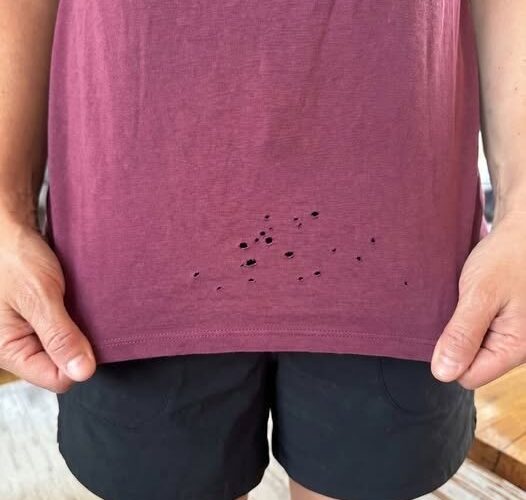
Small, mysterious holes in the midsection of T-shirts and sweaters are a common phenomenon. They are almost never caused by moths, but rather by a combination of mechanical friction and the fabric’s structure.
Here are the main reasons why they always appear in the same spot:
- Friction against trouser buttons and belt buckles
This is the number one cause. The holes almost always appear at navel height because that is exactly where the T-shirt gets pinched between hard objects:
The base of the button or the metal edge of the jeans.
The prong or clasp of a belt. When you move, walk around, or lean against the edge of a table, the thin T-shirt fabric constantly rubs between the belt or button and the table edge or work surface.
- Friction against countertops and tables
Whether it’s a kitchen countertop, an office desk, or a steering wheel or seatbelt while driving, this is the specific height at which we most frequently lean against hard edges in our daily lives. This crushing action causes the fine cotton fibers to eventually break.
- Material quality and thin yarns
Many modern T-shirts are made from very fine, thin cotton yarns (single jersey). To save costs or make the fabric softer, the yarn is often spun less tightly or made from shorter cotton fibers. These fibers are extremely sensitive to localized mechanical stress. - The washing machine cycle (the final blow)
The friction against the belt initially weakens the fibers in a way that isn’t visible to the naked eye. In the washing machine, the damaged fabric finally tears completely due to the spinning action and friction against other garments (such as zippers or eyelets). The hole only becomes visible after washing, even though the damage occurred during everyday wear.
How to prevent these holes:
Cover the belt buckle: Choose belts with rounded edges or use elastic belts that lack a protruding prong.
Tuck in the front of your T-shirt: A partial tuck (the “French tuck”) prevents the fabric from getting pinched between a button and the edge of a table.
Pay attention to fabric density: When buying, look for a higher fabric weight (measured in g/m²) and higher-quality cotton (e.g., combed cotton or Pima cotton).