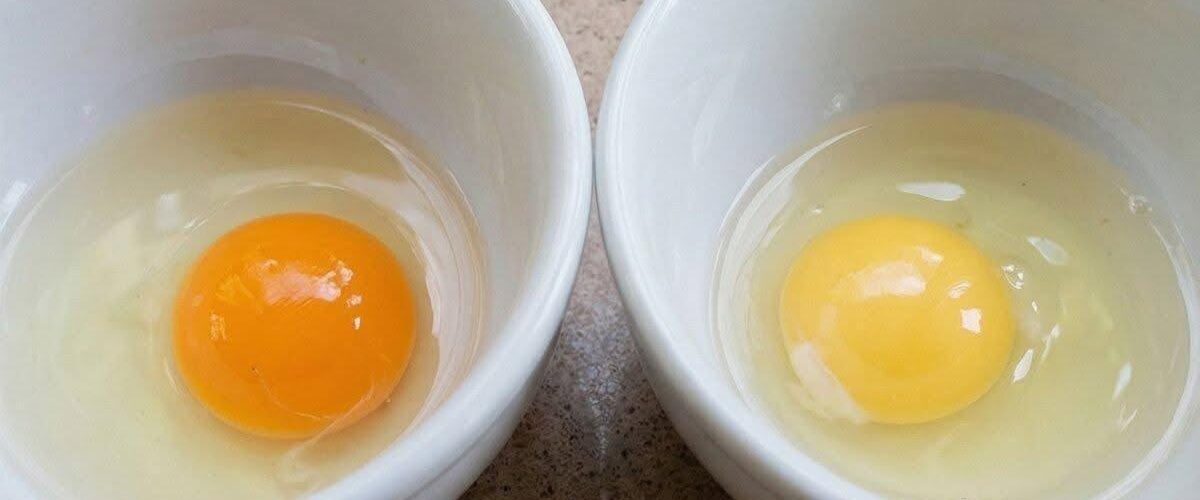
The answer depends on what exactly the yolk contains – the color alone does not directly reflect whether the chicken is healthy.
You didn’t attach a picture, but if you’re choosing from multiple options (e.g. light yellow vs. dark orange yolk), here’s a scientific look at the matter:
What actually determines the color of the yolk?
Diet (carotenoids): Pigments called carotenoids (xanthophylls) affect the color of the yolk. If a chicken eats fresh grass, corn, marigolds or insects, its yolk will be dark orange to dark yellow.
Wheat diet: If a chicken is fed a feed based primarily on wheat or barley, the yolk will naturally be pale yellow, even if the chicken is completely healthy and lives free-range.
Feed additives: In industrial farming, natural or synthetic pigments (e.g., pepper or marigold extracts) are often added to feed to make the yolk orange, as consumers associate this color with quality.
How do you tell the yolk from a healthy, well-fed bird?
When comparing eggs in a pan or bowl, the real signs of quality are:
Firmness and shape: The yolk of a healthy egg is firm, convex, and holds its shape in a high dome.
White consistency: There is a thick, compact white surrounding the yolk that does not spread all over the surface like water.
If you have a specific image or options, please send them and we can evaluate them.