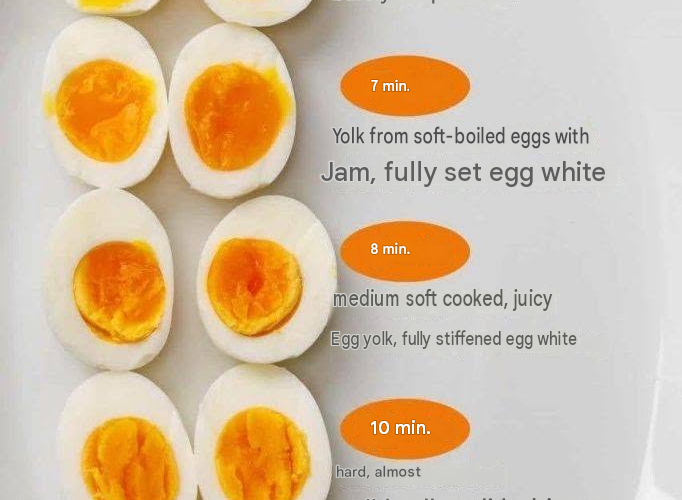
The Secret to Perfectly Hard-Boiled Eggs: Place them in boiling water and immediately stop the cooking process by shock-cooking in ice water after the required time has elapsed.
Cooking Time (in Boiling Water)
Time | Yolk Consistency | Ideal Result/Use
4 to 5 min. Very runny and hot | Hot egg, ready to eat with a spoon in the shell
6 min. Creamy/velvety center, firm white | Soft-yolk egg (ideal for ramen and toast)
8 min. Firm, juicy, orange centers | Salads, sandwiches and sides
10 min. Completely firm and yellow | Russian salad, stuffed eggs
12+ min. Very dry and brittle | A gray ring may form around the edge
Boiling water: Enough water to completely submerge the egg.
Bring the water to a boil in a saucepan.
Add the eggs: Room temperature eggs prevent the shells from cracking. Reduce the heat slightly to avoid turbulence. Carefully lower the eggs into the water using a large spoon.
Cooking time: Start counting as soon as the eggs are in the water.
Let the water simmer gently until the yolks reach the desired consistency.
Boiling with a slotted spoon stops the cooking process and loosens the membrane.
Remove the eggs with a slotted spoon and immediately place them in a bowl of ice water for 3 to 5 minutes.
Peeling: Start at the wide end. Gently tap the egg on a flat surface to scrape off the shell, then peel it in a bowl of water or under running water.
Additional tips: Age of the eggs: Eggs that are 1 to 2 weeks old and refrigerated are much easier to peel than very fresh eggs.
Prevent cracking: Adding a tablespoon of vinegar to the water will help the white set faster if the shell cracks.