This headline sounds like a typical, enticing one from a gardening magazine, but it’s absolutely true! July (and early August) is the most important month of the year for strawberry growers.
Now, after the harvest, it’s decided how many strawberries you’ll harvest next year. During this time, the plants go through what’s called flower bud differentiation – simply put, they lay the foundation for the future harvest.
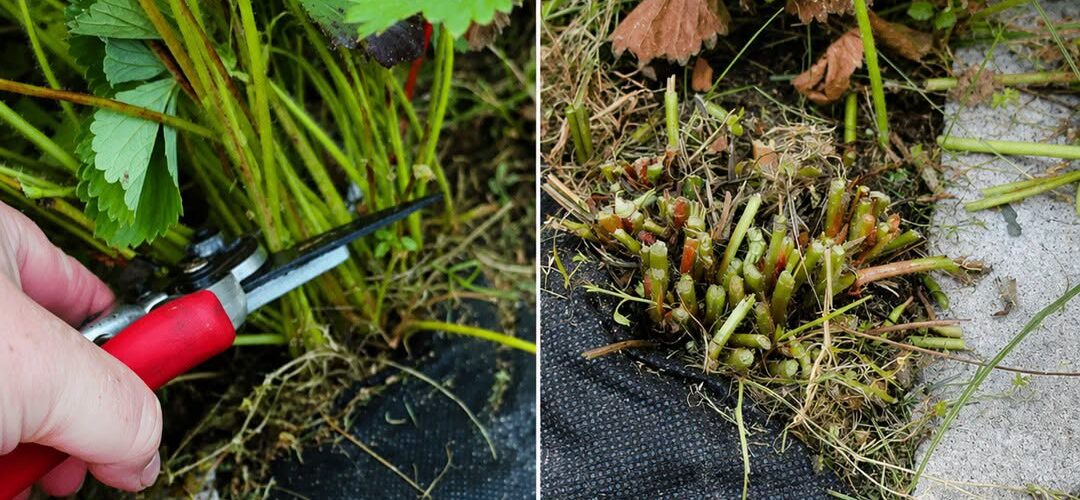
If you want a bountiful harvest of giant strawberries next year, you need to do one crucial thing with each plant now: prune it back drastically.
✂️ Most important step: Radical pruning
As soon as you’ve harvested the last of the fruit, grab a sharp pair of garden shears and get to work. Proceed as follows for each plant:
Remove all old, dry, and spotted leaves. Leave only the young, healthy leaves in the center (the heart). Remove any diseased or spotted leaves.
Remove all runners consistently: In July, the plant invests a lot of energy in producing runners for propagation. If you don’t want new seedlings, cut all runners close to the mother plant. Otherwise, the plant will become weak, and next year you will only get small, sour fruit.
Pay attention to the heart: Never damage the heart of the plant, from which new leaves grow, when pruning.
💧 Three quick steps immediately afterward (for optimal results): After pruning your plants, perform these three quick steps, which only take a few minutes:
Dig and weed: Carefully loosen the soil around the strawberry plants (the soil is shallow, so be careful) and remove any weeds that would deprive them of nutrients and water.
Water thoroughly: Strawberries must not dry out after harvesting. They need sufficient moisture to recover and produce new, healthy leaves.
Fertilize: Use a fertilizer rich in phosphorus and potassium (ideally a special strawberry fertilizer). Save on nitrogen now so you don’t promote leaf growth at the expense of future blossoms.
⚠️ IMPORTANT NOTE: Only perform this radical pruning on June-bearing strawberry plants. For everbearing strawberries (which bear fruit until autumn), simply remove dry leaves and runners. Leave healthy leaves, as they will continue photosynthesizing and thus produce new fruit.