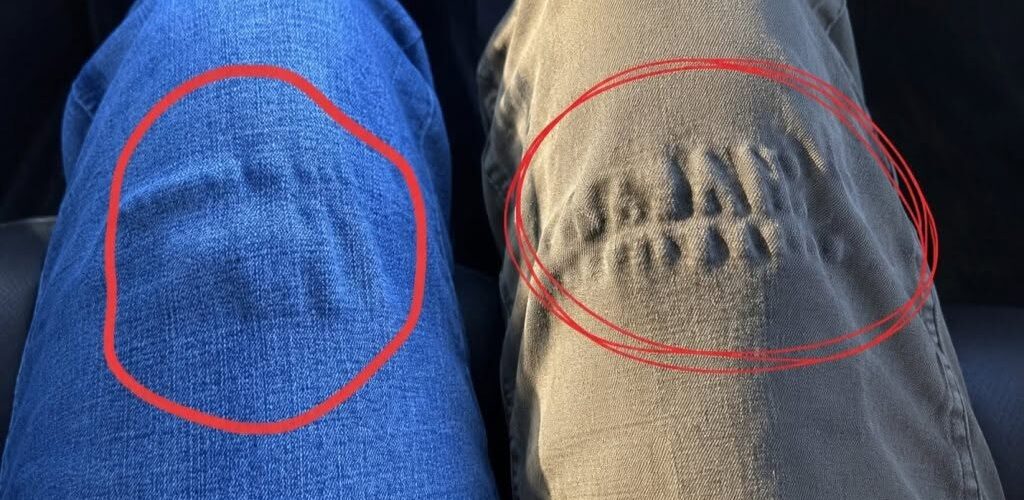
If jeans suddenly ripple after washing—especially along the seams (the infamous “bacon effect”) or in the thigh and crotch area—it’s usually due to an invisible culprit in the fabric: elastane (also known as spandex or Lycra).
While pure cotton jeans might shrink slightly after washing, modern stretch jeans are extremely sensitive to improper care.
Here are the main reasons for these strange ripples and how to protect your jeans from them.
The Causes: Why does the fabric ripple?
Broken elastane fibers (heat damage): Elastane is essentially fine rubber. If stretch jeans are washed at too high a temperature or put in the dryer, these elastic threads melt or break. The cotton lining shrinks during washing, but the damaged elastane can no longer stretch – the fabric develops irreversible creases.
The fabric softener mistake: Fabric softener coats the fibers like a film and seeps into the elastic threads. This causes the elastane to lose its elasticity and elasticity.
Mechanical stress during spin cycles: When jeans are washed at high spin speeds (e.g., 1200 rpm or more), the fabric is crumpled and stretched excessively. If the jeans are then hung up wet, creases can become permanently embedded.
Can the creases be repaired?
Once the elastane is damaged, unfortunately, there is no permanent solution – the fiber structure is destroyed.
The stretch test: Put on the jeans. If the creases disappear as soon as the fabric is under tension against your body, the elastane is still intact. In this case, gently ironing the jeans into shape with a little steam and spray starch can help.
If it’s the seams: Sometimes it’s due to manufacturing defects (the sewing machine pulled the fabric layers unevenly while sewing them together). Often, the only solution is to take them to a tailor.
How to prevent rippling in the next wash
To keep your jeans smooth in the future, a small adjustment to your washing routine will help:
Wash cold and gently: Choose a maximum temperature of 30°C (cold is better) and a delicate cycle.
Reduce the spin cycle: Set your washing machine to a maximum of 400 to 600 revolutions per minute. This prevents the wet fibers from being excessively compressed.
Absolutely no fabric softener: Instead, add a splash of white vinegar to the fabric softener compartment – this softens the water and preserves the elasticity.
No tumble dryer: Stretch jeans should never go in the dryer. After washing, pull the trousers into shape while wet (especially smoothing the seams) and let them air dry.