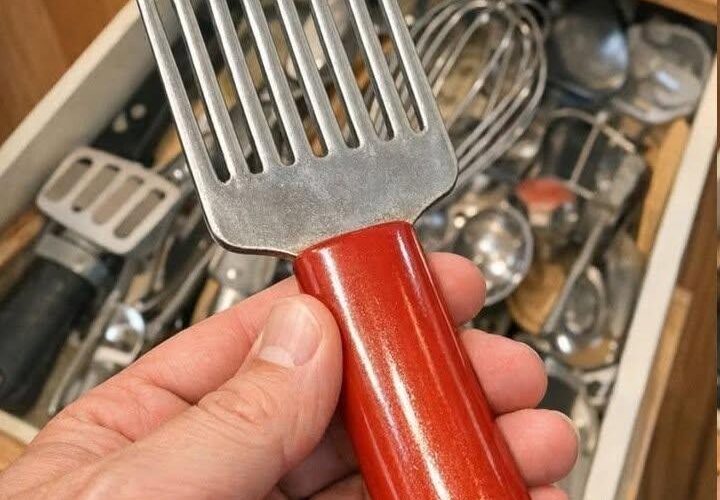
That sounds like an exciting find! When you rummage through a box of old dishes or kitchen utensils, you often come across tools that hardly anyone uses anymore.
The Bakelite handle already gives us a clue as to its approximate age: This material (the first fully synthetic plastic) was used extensively for kitchen utensils, especially between the 1920s and 1950s, because it is heat-resistant and robust.
Based on your description—a huge point, but with metal prongs that are too thick—three historical kitchen tools are particularly likely:
- A meat holder/carving tool (Very likely)
If it looks like a giant fork, but the prongs are noticeably thick, flat, or oddly shaped, it is often a meat or roast holder. 1. Function: This was used to skewer a large piece of roast (e.g., the Sunday roast) to hold it steady while carving (slicing) with a knife, preventing it from slipping. The prongs had to be thick enough so they wouldn’t bend under the pressure of the heavy meat. - An ice pick
In the days before modern refrigerators, households received large blocks of ice (or retrieved them from the ice cellar) to keep food cold.
Function: These tools often had a heavy Bakelite handle and either a thick, hefty point or several thick prongs at the end for chipping chunks off a large block of ice.
- A historical meat tenderizer (“steaker”)
Today, flat meat tenderizers are most commonly used, but in the past, there were devices that looked more like torture instruments.
Function: A handle with several thick, pointed metal prongs arranged side by side. This was used to strike tough meat to cut through the fibers.
What exactly does it look like?
To completely solve the puzzle:
How many of these metal prongs/points does the thing have? Is it just one thick point, or are there several (like on a fork or crown)