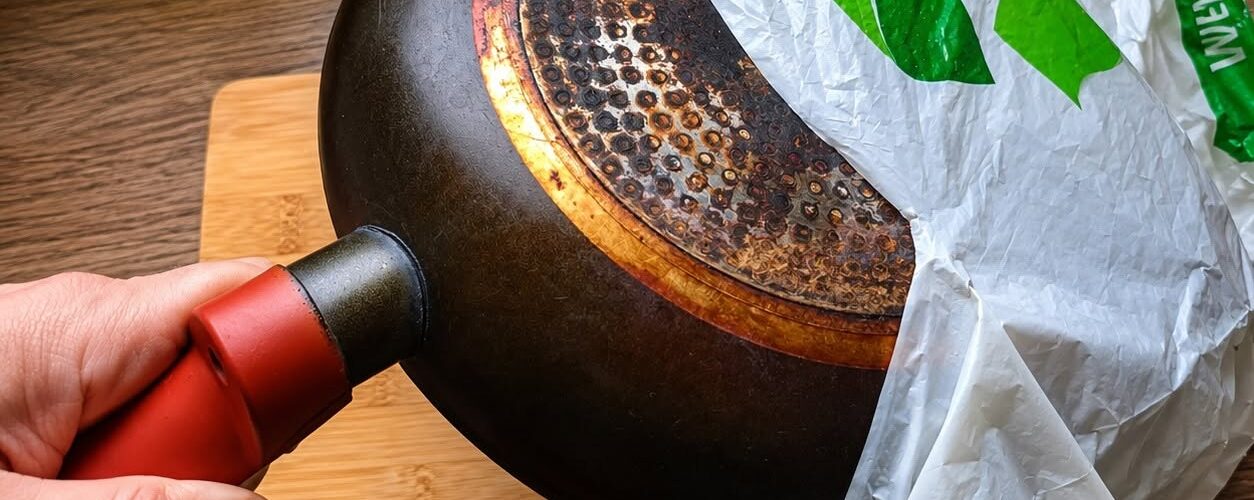
This trick sounds like a dream come true for anyone who has ever spent half an evening scrubbing a burnt-on baking dish or pan. And the best part? It really works!
The secret isn’t in the plastic bag itself, but in what you put in the pan. The bag acts as a perfect insulator, trapping the cleaning fumes inside and preventing them from evaporating. This allows the chemical reaction to work directly on the burnt-on residue overnight, and you can simply wipe it away in the morning.
Here’s a step-by-step guide on how to do it and what you need to pay special attention to so your pan doesn’t get damaged.
Method 1: Ammonia – For the toughest burnt-on residue
This is a real “chemistry lab” that will dissolve even the oldest black crust on the bottom of your pan.
What you’ll need:
A sturdy plastic bag (ideally with a zipper or a regular garbage bag with a rubber band).
Approximately 50 ml of liquid ammonia (ammonia solution, available at drugstores or paint stores).
Procedure:
Safety first: Ammonia has a pungent and aggressive odor. Do this step outside, for example on a balcony, in the garden or with a window wide open.
Place the container in the bag.
Pour the ammonia into the bag – be careful, it doesn’t have to be poured onto the container; it’s enough if it reaches the bottom of the bag, as the fumes will do the cleaning!
Seal the bag airtight immediately.
Leave it for 12 to 24 hours (ideally outside or in a well-ventilated room).
The next day, open the bag outside, remove the container and rinse it. Burnt-in grease can be easily removed with a regular sponge.
Method #2: Baking soda and vinegar – a gentler homemade alternative
If you want to avoid strong ammonia, this effervescent alternative is also ideal. The fumes are less intense, but the closed bag creates a humid environment in which the baking soda can loosen dirt.
What you will need:
Baking soda
Vinegar
Plastic bag
Procedure:
Mix the baking soda with a little water to form a thick paste.
Thoroughly rub all the burnt spots on the pan with this paste.
Place the pan in the bag and spray a little vinegar (the mixture will fizz).
Seal the bag tightly and leave it overnight.
The next morning, scrub the pan with the rough side of a sponge and rinse with warm water.
⚠️ WARNING: Which pans is this method NOT suitable for?
Before you start, check what material your pan is made of. This trick can irreparably damage some materials:
YES: Stainless steel, cast iron (be careful with ammonia, it can wash away the protective oil layer – the so-called patina – which you will then have to restore) and enamel.
NO: Aluminum and Teflon! Ammonia and highly concentrated sodium hydroxide attack aluminum – the pan will lose its shine, turn black and be destroyed. With Teflon and other non-stick coatings, there is a risk that the protective layer will peel off. Therefore, use this method mainly on stainless steel cookware and on the outside (bottom) of pans, where burnt-on grease accumulates the most.
Are you trying to clean an old stainless steel classic or save the bottom of a newer pan?