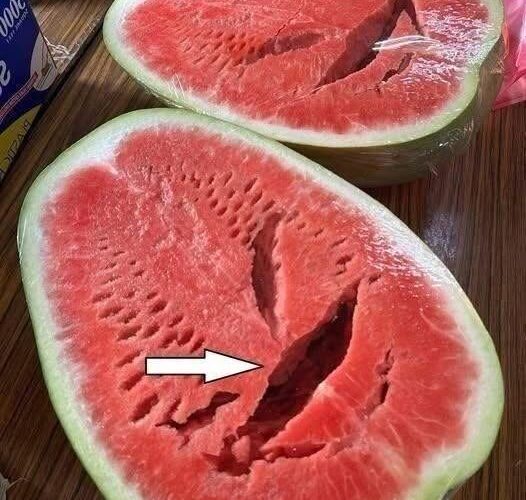
Internal cracking inside a watermelon—often forming a distinct three-pronged or swirling pattern—is a natural phenomenon known as Hollow Heart. Despite clickbait claims circulating online, it is entirely safe to eat.
What Causes Hollow Heart?
- Inadequate Pollination: Cold or rainy weather during the flowering stage limits bee activity. When pollination isn’t fully completed, the fruit’s inner compartments (carpels) don’t fuse seamlessly as the melon expands, leaving gaps.
- Not Hormones or Chemical Spikes: Internet myths often claim these cracks are caused by toxic plant hormones or artificial growth chemicals. Agricultural research confirms it is purely a physical development issue, not a disease or chemical safety hazard.
Is It Safe and Tasty?
- Safety: As long as the outer rind is intact (no exterior punctures, soft spots, or cracks exposing the flesh to external bacteria), the fruit inside is microbially safe.
- Flavor: Mild hollow heart actually tends to concentrate natural sugars near the gaps, often making the melon taste slightly sweeter.
- Texture: In severe cases, the flesh around the gaps might feel a bit drier or pulpier than usual, but it remains non-toxic.
When to Actually Throw a Watermelon Out
Discard the watermelon if you notice genuine signs of spoilage rather than simple internal cracking:
- A sour, fermented, or chemical smell
- Slimy, mushy flesh or visible mold
- Cracks on the outside of the rind that allowed dirt or bacteria inside
- Fizzing or leaking fluid from the exterior rind