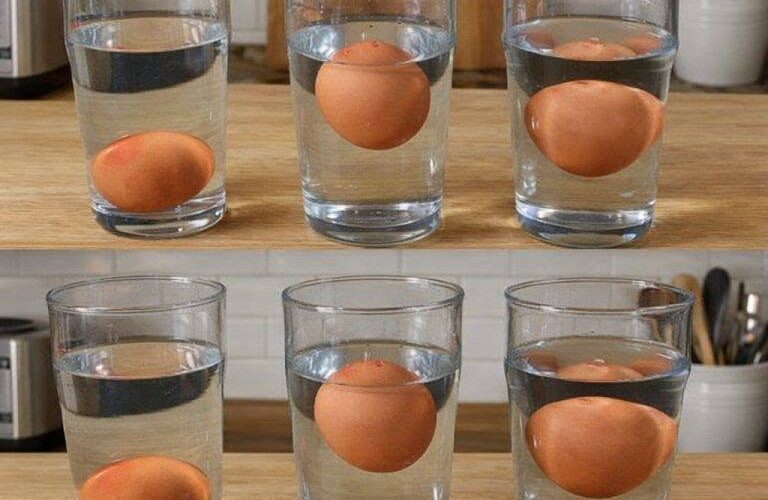
Here are 5 simple and reliable methods to check the freshness of an egg at home:
The Water Test (Immersion Test): Fill a deep bowl or glass with cold water and carefully place the egg inside:
Fresh: It sinks completely to the bottom of the bowl and lies on its side.
A few weeks old (still good): It stays at the bottom, but the wider end rises slightly.
Spoiled: It floats on the surface. The air cell inside the egg grows over time, so a spoiled egg floats to the top.
The Shake Test: Hold the egg to your ear and shake it gently:
Fresh: You hear no sound.
Spoiled: It makes a dull, popping sound. The egg white and yolk become thinner with age, and the larger air cell allows the contents to circulate freely.
The crack test (condition check): Crack the egg onto a flat plate:
Fresh: The yolk is round, clearly visible, and firm. The egg white is firm, stays around the yolk, and barely spreads.
Spoiled/Old: The yolk is flat and breaks easily. The egg white is runny and spills over the plate.
The smell test: Crack the egg into a separate container (not directly into the food):
Fresh: Neutral, barely perceptible odor.
Spoiled: Immediately emits a strong, pungent odor of rotten eggs (hydrogen sulfide) when cracked. In this case, discard immediately!
Light test: Darken the room and hold a strong light source (e.g., your cell phone’s flash) to the wide end of the egg:
Fresh: The light shines through evenly; the air bubble at the end of the egg is small (3–5 mm).
Spoiled: The inside of the ice is dark, cloudy or spotted, and the air bubble is noticeably large.