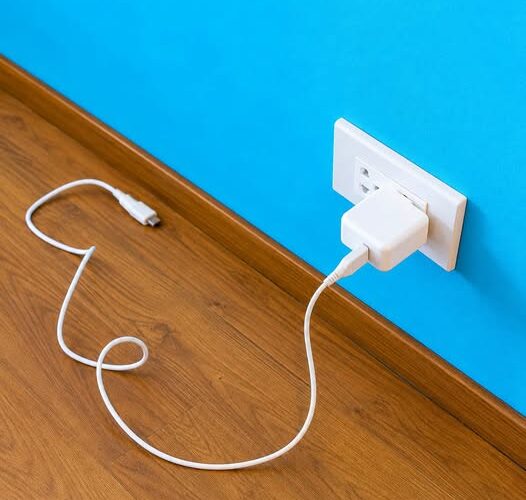
Your brother-in-law is speaking from a strict trade-safety mindset! While calling it strictly “forbidden” might be a bit dramatic for everyday life, electricians generally hate seeing empty chargers plugged in for a few solid technical reasons.
Why Electricians Advise Against It
- Vampire / Phantom Load: Even when no phone is attached, a plugged-in charger keeps its internal transformer energized, continuously pulling a microscopic amount of power. While modern chargers consume negligible energy (costing roughly $0.10 to $0.50 per year), electricians view any unnecessary live load as poor practice.
- Fire Hazard from Low-Quality Knockoffs: Name-brand chargers (like Apple or Samsung) have robust internal safety circuits. However, cheap knockoff chargers off the internet often skip critical thermal and short-circuit protection. If an internal component fails while continuously plugged into 120V/240V power, it can overheat, melt, or trigger a fire.
- Physical Damage and Short Circuits: An exposed USB tip dangling off a couch or desk still carries a low-voltage secondary current. If the connector contacts water, a metal bedframe, or gets chewed on by a pet, it can spark, short out, or burn out the adapter.
- Component Wear & Tear: Modern chargers use switch-mode power supplies with capacitors and semiconductors. Keeping them continuously energized under line voltage generates subtle internal heat, slowly degrading internal components and shortening the charger’s lifespan.
- Power Surges: During a lightning storm or grid spike, any device physically connected to an outlet can take the brunt of the voltage surge, potentially frying the charger’s internal board.
While keeping a high-quality, name-brand charger plugged in won’t ruin your electric bill or blow up your house, unplugging unused adapters—or toggling them off on a switchable power strip—is the safest habit.