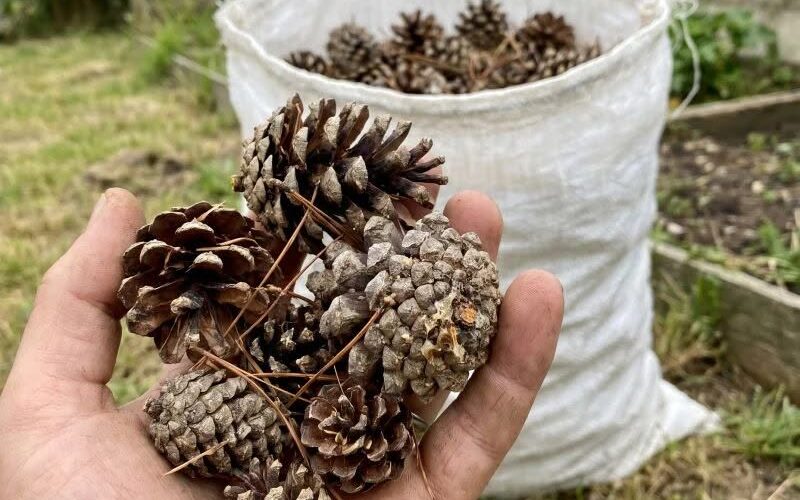
This sounds like a great tip for all gardeners who want to save money and garden organically at the same time! Pine cones are a great, though sometimes underestimated, helper in the garden. They can perform several functions at once, but their effect as a direct fertilizer substitute is rather indirect.
Here’s an overview of how pine cones help soil and vegetables:
Ingenious natural mulch
Spreading pine cones around beds or shrubs creates an excellent mulch layer.
They retain moisture: They prevent water from evaporating from the soil, so you don’t have to water your vegetables as often.
They protect the roots: In summer, they protect the root system from overheating, and in winter from frost.
Weed control: The dense layer of pine cones blocks out light, significantly inhibiting weed growth.
Improve soil structure and drainage: Pine cones are a great help in heavy, clay soil. Bury them at the bottom of a raised bed or in deeper soil layers to create a natural drainage layer. This loosens the soil, allowing roots to receive sufficient oxygen and preventing rot from waterlogging.
Protection against pests: Are your neighbors’ cats digging up your flower beds? Or are you battling slugs and snails? Sharp pine cones act as an effective mechanical barrier. Cats have difficulty walking over them, and slugs and snails avoid them due to their texture.
⚠️ Important: The myth of pine cones as fertilizer
One thing needs to be made clear: Pine cones alone do not enrich the soil with nutrients as quickly as conventional fertilizer. They decompose very slowly (even over several years).
Soil acidification: Pine cones (and needles) slightly increase the acidity of the soil. This is ideal for blueberries, strawberries, hydrangeas, or potatoes. Classic vegetables (like tomatoes, cucumbers, or lettuce) don’t tolerate overly acidic soils. Nitrogen deficiency: When wood (like pine cones) decomposes, soil bacteria extract nitrogen from the soil. Paradoxically, if you were to work the pine cones directly into the soil with the vegetables, they could temporarily deplete the soil of nitrogen.
Conclusion: Pine cones are excellent for mulching, soil aeration, and water retention (which greatly benefits plant growth). However, if your vegetables are deficient in nutrients, compost, nettle tea, or chicken manure are more suitable.
Are you planning to use pine cones as mulch around a specific vegetable or would you like to improve the overall structure of your garden bed?