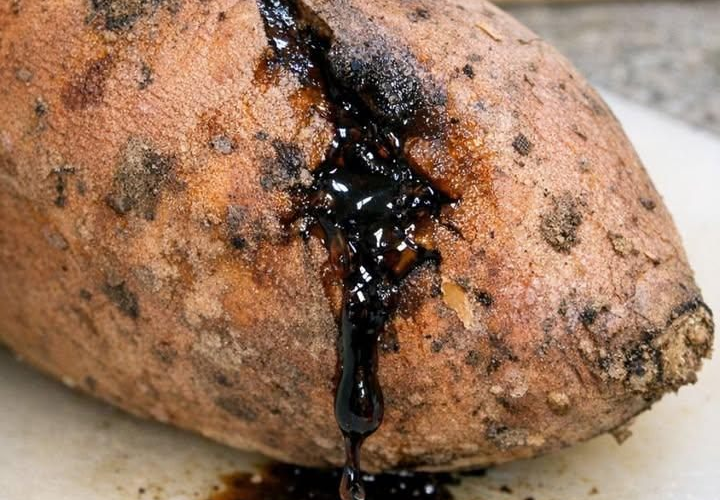
Don’t worry, you don’t have to throw the sweet potato away! If a milky or dark, sticky liquid oozes from a cut or slightly damaged sweet potato, it’s usually a sign of quality, not spoilage.
Here’s the solution to the sticky mystery:
It’s a mixture of starch and sugar.
The liquid, which often appears as white juice and turns dark and resinous when exposed to air, is a mixture of starch and natural sugar (mainly sucrose).
Why does this happen? When the sweet potato is very fresh and full of juice, this juice oozes out even with the slightest damage to the skin.
What does this mean? It’s actually proof that the tuber is particularly fresh and sweet. In technical terms, this juice is sometimes considered part of the plant’s milky sap.
How to tell it from rot
Although the sticky drops are harmless, there are clear signs that a sweet potato is actually spoiled. Here’s a direct comparison:
Characteristic: Harmless sap (sugar/starch) True rot
Consistency: Sticky, dries hard like resin. Mushy, soft, or slimy.
Odor: Neutral or slightly sweet and earthy. Unpleasant, pungent, or musty.
Color: Whitish, turns dark brown/black when exposed to air. Large dark spots, mold growth.
Texture: The tuber is firm overall. The tuber yields to finger pressure.
What should you do?
Simply wash it off: You can simply wash the sticky spots under running water before peeling.
Cook it normally: The liquid will evaporate during cooking or baking, and the spots will no longer be visible after cooking.
Check storage: If many of these drops are oozing out, it’s best to store the remaining tubers in a dark, cool (but not in the refrigerator!), and dry place.
In short: The dark drops are essentially the sweet potato’s “honeydew.” As long as the tuber is firm and smells good, it’s perfectly safe and probably even particularly delicious.
Have you stored the sweet potatoes for a while, or are they fresh from the store?