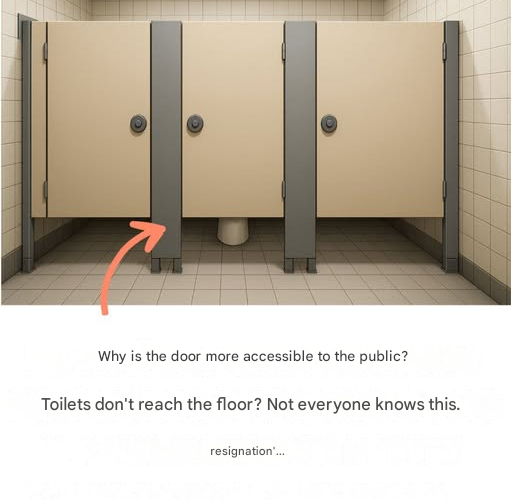
This is one of those questions you only think about when you’re already sitting in a stall. At first glance, it might seem like a cost-cutting measure or an invasion of privacy, but there are actually solid, practical reasons behind the shortened doors.
Here are the main factors behind why this design is almost a global standard:
- Hygiene and Cleaning
Public restrooms need to be cleaned several times a day.
Efficiency: Cleaning staff can simply wipe under the doors with a mop or cleaning machine without having to unlock each stall individually.
Ventilation: The gap allows for better air circulation. Since odors quickly become unpleasant in enclosed, confined spaces, the airflow from below helps keep the stall “fresher.”
- Safety in an Emergency
This is probably the most important point. If someone in the stall loses consciousness or has a medical problem, it’s easier to spot from the outside.
First Aid: In an emergency, rescue workers can crawl under the door or break it down more easily without damaging the entire wall structure.
- Deterrence of Undesirable Behavior
A certain degree of visibility (or at least the feeling of not being completely isolated) deters people from doing things that don’t belong in a public restroom:
Vandalism (graffiti, destruction).
Drug use.
Sexual activity.
Simply “loitering” on a mobile phone (the slight social control leads to a faster turnover).
- Costs and Maintenance
It sounds trivial, but it’s an economic factor:
Material Savings: Less material means lower production costs.
Precise Fit: A door that doesn’t reach the floor doesn’t need to be fitted to a (perhaps uneven) tiled floor with millimeter precision. This makes installation and replacement much simpler.
- The “Occupied” Check
You can immediately see if the cabin is occupied without having to jiggle the handle – which is usually a rather awkward situation for both parties.
Interesting side fact: In many European countries (like Germany), the gaps are often significantly smaller than, for example, in the USA. There, the gaps are sometimes so large that you could almost make eye contact with the waiting passengers – which regularly causes a culture shock for many travelers