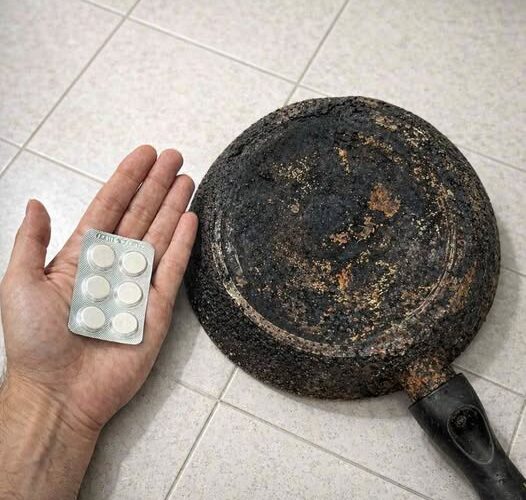
This sounds like a classic internet video, promising to remove even the most hopeless burnt-on food with a dash of magic and plenty of foam. Most of these “controversial” tricks involve a combination of home remedies and chemicals that you wouldn’t normally mix in your cupboard.
Here are the three most common methods for saving a pan you thought was beyond saving – and why they divide opinions:
- The Classic: Baking Soda (or Baking Powder) and Vinegar
This is the “volcanic eruption” in your pan.
How it works: Sprinkle baking soda on the burnt areas, pour vinegar over it, let it foam up, and then briefly boil it with water.
Why it divides opinions: Chemically speaking, the base (baking soda) and acid (vinegar) neutralize each other to form water and salt. The cleaning effect comes primarily from the bubbling (mechanical dissolution) and the heat. Many find it ingenious, while others consider it pure alchemy with no real added value compared to simple dish soap.
- The “Radical”: Concentrated Dishwasher Tablet
How it works: Put one tablet in the pan, add a little water, bring to a boil briefly, and let it soak overnight.
Why it’s divisive: Dishwasher tablets are highly concentrated and aggressive. It works wonders on stainless steel pans, but on aluminum or Teflon pans, this trick can permanently ruin the coating or the material. This is often the reason for heated discussions in the comments.
- The “Salt-Scourer Trick” (for cast iron)
How it works: Put a generous layer of salt in the dry pan and scrub vigorously with a cloth or a potato.
Why it’s divisive: For cast iron enthusiasts, this is the only true method. However, if you try this with a coated pan, you’ll completely scrape off the non-stick coating – the pan will then be ruined.
My pro tip for stainless steel (completely undisputed):
Before resorting to harsh chemicals, try rhubarb or citric acid. The oxalic acid they contain often dissolves limescale and burnt-on food effortlessly without damaging the metal.
Important warning: Never mix cleaning agents indiscriminately (e.g., chlorine bleach with vinegar)! This can produce toxic fumes.
Do you have a specific pan in mind – perhaps a stainless steel one or your favorite coated pan that’s been exposed to too much heat?