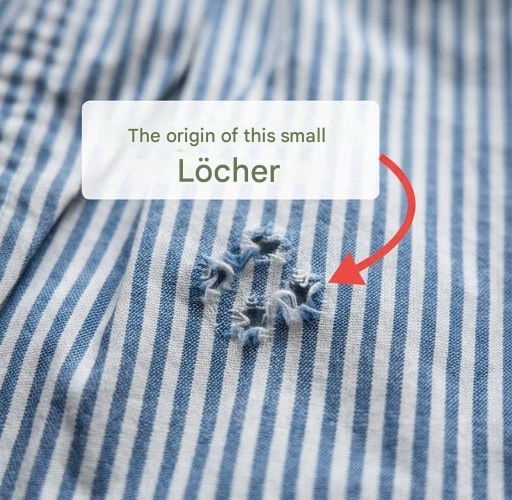
The mystery surrounding those tiny holes – usually around waist level on T-shirts and delicate sweaters – is almost a modern myth. If you’ve already ruled out belt buckles, sharp edges in the washing machine, or even moths, one prime suspect remains that almost no one considers:
The invisible culprit: Friction against the countertop
Most of these holes are caused by so-called pilling trauma on hard surfaces. When you’re standing in the kitchen cooking or working at your desk, your body presses your T-shirt against the edge of the countertop or table, right at belt or waistband level.
The effect: With every movement, there’s minimal but constant friction between the hard edge (e.g., a granite countertop or wooden table) and the fabric.
The result: The fine cotton fibers become brittle and tear. Since modern “fast fashion” is often made of single jersey (a fabric knitted from a single thread), even a single small tear is enough to create a perfectly round hole after the next wash.
Three other “secret” causes:
- The “zipper factor” (inside the pants)
Even if you don’t wear a belt, your jeans have a button and a zipper. Often, the inside of the button or the top of the zipper teeth is sharp. When your T-shirt is lying over it and you move, the jeans act like a “scratch.” - The seatbelt or shoulder bag
Pay attention to where the seatbelt in your car or the strap of your bag runs. The constant vibration and friction while driving or walking literally grinds down the fibers. - Silverfish (instead of moths)
We always immediately think of moths, but silverfish love starch. If you starch your laundry or if there are traces of sweat and skin flakes in the fabric, these tiny insects will nibble at the fibers. Unlike moths, they often leave behind irregular, very small holes.
Here’s how to prevent the “hole phenomenon”:
Wear an apron while cooking: It not only protects against stains but also acts as a buffer between your T-shirt and the countertop.
Check the fabric quality: Look for combed cotton or fabrics with a higher weight (grammage). The thinner the shirt, the faster the threads will wear through.
Use a laundry bag: Even if the washing machine itself is fine, zippers on other garments in the drum can damage your delicate shirts. A laundry bag is the best protection.
By the way, did you know that you can stop these tiny holes from growing to the size of a euro coin after washing by applying a tiny drop of clear nail polish (on the inside)?
“` Have you ever noticed holes in your trousers in exactly this “typical” spot, just above the waistband?