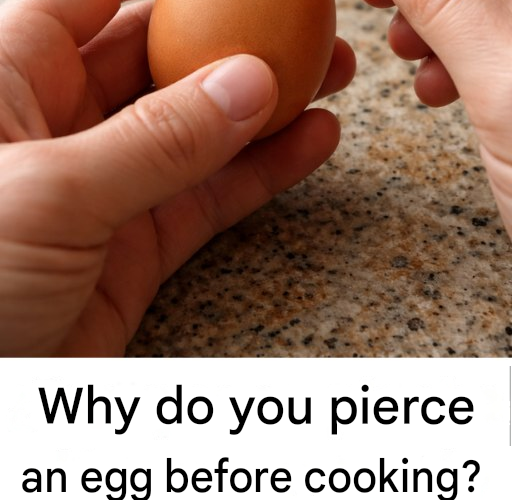
“Piercing” an egg is a classic pro trick that makes perfect physical sense, even if it seems counterintuitive to break an egg before cooking.
Here’s the secret to the little hole:
Why is piercing so important?
Have you ever wondered why hard-boiled eggs often have a flat, indented bottom? It’s because of an air bubble at the blunt end of the egg.
Pressure equalization: As the egg slides into the boiling water, the air inside it quickly expands. If this air can’t escape, the pressure builds up so much that the shell cracks. The hole acts as a safety valve.
The perfect shape: Piercing the egg releases the air, allowing the egg white to fill the space all the way to the arch. The result is a perfectly oval egg without the unsightly indentation.
Easier peeling: Opinions vary on this one, but many chefs swear by the fact that minimal water seeps between the shell and membrane through the hole. This helps the membrane separate from the shell more easily when the egg is cooled in cold water.
How to do it right (professional checklist)
Where? Always pierce the blunt end. That’s where the air cell is. The pointed end contains the yolk and there’s no air – if you pierce there, you risk making a mess.
With what? A special egg piercer is ideal, but a simple, clean needle will do. Just pierce it about 2-3 mm deep.
The “shock” moment: For perfect peeling, cooling the egg in ice-cold water after boiling is more important than the piercing itself. The sudden change in temperature causes the egg white to contract slightly and separate from the shell.
A little myth-busting
Science says that the age of the egg has a much bigger impact on how easy it is to peel than the piercing. Very fresh eggs are extremely difficult to peel because the membrane is still firmly attached to the shell. So, if you need eggs for a salad, it’s best to use ones that have been in the fridge for a few days!
Try this next time you have breakfast – just pierce half of the eggs and see if you can feel the difference in peeling!