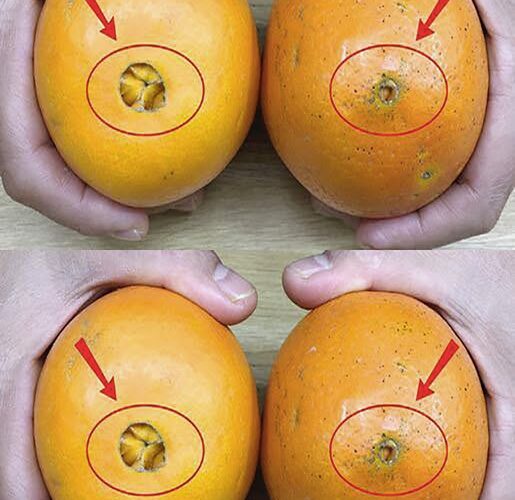
Step inside my “virtual stall” for a moment. If you want to stop gambling on whether your oranges will be honey-sweet or a dry, fibrous disappointment, you need to stop looking at the color and start looking at the weight and the pores.
Here is the greengrocer’s secret playbook for picking a winner every single time.
1. The “Heavyweight” Rule
This is the most important test. Pick up two oranges of the same size. The one that feels significantly heavier is the one you want.
- Why: A heavy orange is packed with juice. A light orange has a thick pith and has likely started to dry out inside.
2. Check the “Belly Button” (Navel Oranges)
If you are buying Navel oranges, look at the bottom (the side opposite the stem).
- The Pro Tip: Look for a larger, deeper “navel.” Generally, the more pronounced the navel, the sweeter the fruit.
- The Reason: That navel is actually a second, tiny “twin” orange growing inside. A well-developed navel is often a sign of a more mature, sugar-rich fruit.
3. The Skin Texture (The “Pore” Test)
Ignore the brightness of the orange color (many great oranges are dyed or naturally a bit green). Instead, look at the texture:
- Smooth & Thin: You want skin that is relatively smooth with fine pores. This usually indicates a thin skin and more juice.
- Rough & Pitted: If the skin looks like a golf ball with deep craters, it’s likely “thick-skinned.” You’ll be paying for a lot of peel and very little fruit.
4. The “Sniff and Squeeze”
Don’t be shy—get your hands on the fruit.
- The Squeeze: Give it a gentle firm squeeze. It should be firm but have a slight “give,” like a bouncy ball. If it’s rock hard, it’s not ripe. If it’s mushy, it’s fermented.
- The Sniff: Smell the stem end. A sweet orange will actually smell like citrus through the skin. If it has no scent, it was likely picked too early and won’t be very sweet.
Quick Cheat Sheet: Avoid These
| Sign | What it Means |
| Spongy spots | The fruit is starting to rot or mold internally. |
| Dull, wrinkled skin | The orange is old and has lost its moisture. |
| Light as a feather | It’s all “bread” (pith) and no juice. |
Greengrocer’s Secret: Store your oranges on the counter if you’re eating them within a few days—they are juicier at room temperature. If you need them to last weeks, put them in the crisper drawer of the fridge!
What kind of oranges are you looking at today—standard Navels, or are you hunting for something more exotic like Blood Oranges or Valencias?