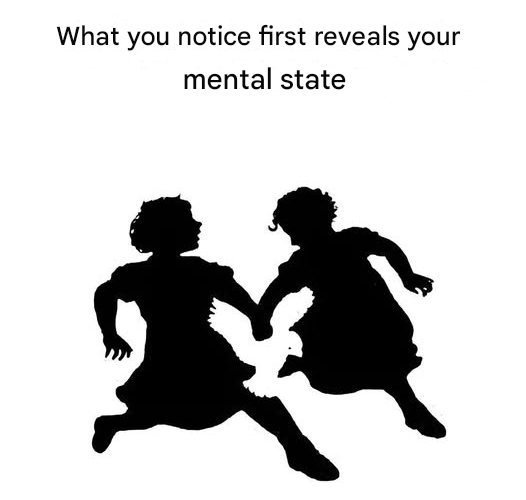
This type of post is a classic psychological “hook.” It plays on our natural desire for self-knowledge and the knowledge that we are special in some way. Usually, there is a picture hidden underneath, where you can see either two faces or a vase (or maybe a tree vs. a lion).
Here’s a breakdown of what such tests and your “first look” really reveal about you:
- Pareidolia: The Brain as a Detective
Our brains are evolutionarily wired to look for familiar patterns in chaos. If you see a face first, it doesn’t necessarily mean you are empathetic, but it does mean that your brain prioritizes social interaction (which our ancestors did to survive). If you see an object, your brain may be more focused on details and structure. - Current Mood (Priming)
What you see first often doesn’t say anything about your DNA, but about what you’ve been doing for the past 10 minutes.
If you’ve just finished eating, you’ll probably see food in the abstract blur.
If you’re stressed, your gaze will be more likely to be drawn to sharp shapes or warning signs.
- Why do we enjoy it so much?
Psychologically, these tests work on the principle of the Barnum effect (just like horoscopes). The description of the result is usually so general (e.g. “you have strong intuition, but sometimes you doubt”) that absolutely everyone can find something in it.
What would you find in the “first comment” under such a post?
Usually people write things like:
“I saw an old woman first, what does that mean? I hope I’m not unlucky!”
AI’s real answer: It just means that your right hemisphere processed the visual data a millisecond faster than your left and connected the dots into an image it already knows. Your inner world is much deeper than a single optical illusion, but it’s great for 30 seconds of fun.
What about you? When you look at a cloud in the sky, do you see animals or geometric shapes?