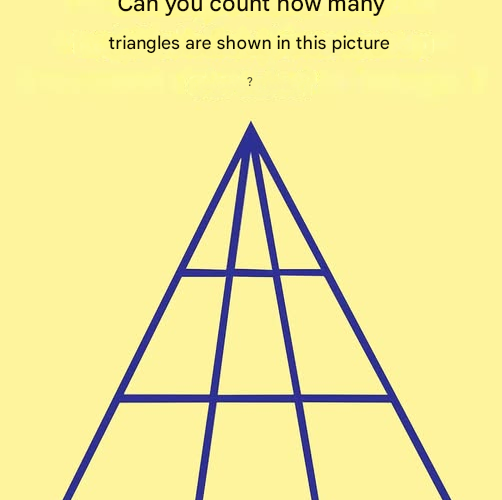
Challenge accepted! Geometric puzzles show us that our eyes and brain don’t always tell us the whole truth. They often deceive us with perspective, contrast, or color.
Since I’m an AI, I can’t see the image in front of me (unless you upload it). Test your visual acuity and attention with one of the most difficult classic geometric puzzles.
Imagine the following scenario:
🧠 Geometric Puzzle: “Lost Square”
Imagine a right-angled triangle made up of four colored pieces (e.g., two smaller triangles and two shapes resembling the letter L).
You assemble these pieces into a large triangle—everything fits. You rearrange the same pieces to create the exact same large triangle. Suddenly, there’s an empty space in the middle the size of a square!
The question is: How can a hole appear in one case when using the same pieces, even though the total area of the pieces hasn’t changed?
Why do 90% of people fail at geometric puzzles?
Assumption of a straight line: Our eyes automatically connect points to form a straight line, even if there’s a small break (e.g., in the Curry Paradox described above).
Lighting: Bright objects on a dark background appear larger than dark objects on a light background, distorting the perception of geometric shapes.
Cognitive completion: The brain fills in familiar shapes instead of seeing the ones that are actually there.
Would you like to continue?
If you have a specific image in mind (e.g., “How many triangles do you see in this picture?”), describe it to me or send me a link. These puzzles are often based on the fact that triangles are nested within each other, and people typically count 30% fewer than are actually present.
So, how many triangles can you count in a classic “star” made up of two large, overlapping triangles? (Most people would say 6, but the correct answer is different…)