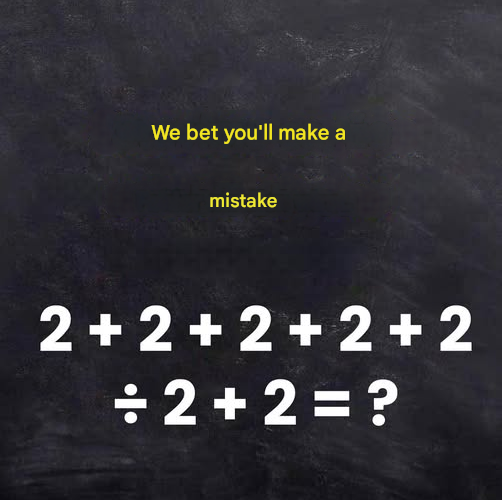
The phenomenon of “99% of people solving it incorrectly”: Why does our brain fail at simple riddles? You’ve probably seen headlines like “Only a genius can solve this in 10 seconds” or “99% of people solving it incorrectly.” Even though this sounds like cheap clickbait, an interesting psychological trap lies behind these figures. Why do we still fail at elementary logic problems, even though we have access to all the world’s knowledge?
Let’s find out how this works. 1. The “fast thinking” trap. Nobel laureate Daniel Kahneman explained it best: We have two thinking systems. System 1: Fast, intuitive, immediate. He says: “I’ve already seen it, the answer is obvious!” System 2: Slow, analytical, inert. It only kicks in when we force ourselves to check the facts.
Most viral puzzles are designed so that System 1 provides the answer first. When you see a question about “a bat and a ball for $1.10,” your brain screams “10 cents!” even though the correct answer is 5.2.
The blind spot effect: When we’re told that 99% of people are wrong, two types of reactions occur: Excitement: “I’m definitely in the 1%!” Bias: We look for a trick where there isn’t one, or we ignore an obvious detail because we’re too focused on the complexity. 3. Why do these puzzles go viral? It’s pure
self-affirmation psychology. When you find the right answer to an “unsolvable” problem, you experience a massive dopamine rush. We share it to demonstrate our superiority, or conversely—to see how “stupid” others are, just like us.
The three most common types of puzzles that “overwhelm” our brains: Puzzle type: What’s the trick? Second-grade math: The order of operations (multiplication before addition) is the first thing adults forget. Language traps: Questions where the answer is hidden in the wording itself. Optical illusions: The brain sees something that isn’t there or ignores unnecessary details.
My conclusion: The “99%” claim is usually an exaggeration to grab attention. But it perfectly illustrates our biggest weakness: We trust our first impressions too much.
And what about the puzzle from the beginning? Let’s define the conditions: Do I also belong to the 1%, or does my algorithm also choose the path of least resistance?