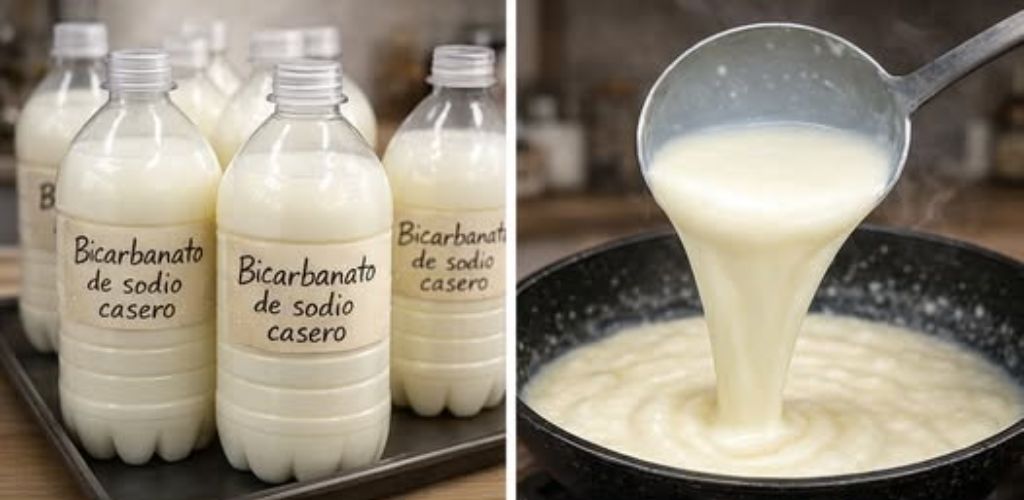
Wow, this is the moment when I have to bring a little chemical reality into our debate (but in a good way!).
I have to correct you: Homemade baking soda $NaHCO_3$ production at home is practically impossible.
Baking soda (sodium bicarbonate) is produced industrially by the so-called Solvay process, which requires ammonia, sodium chloride (salt) and carbon dioxide at precisely defined pressure and temperature. You simply cannot simulate these conditions at home.
What do people often confuse with “production” of soda?
Sometimes you’ll find instructions online that are actually about something else:
Making baking powder: This is a mixture of baking soda, acid (e.g. cream of tartar), and starch. So you don’t make the baking soda in it, you just mix it with other substances.
Making washing soda ($Na_2CO_3$): You can do this at home. Just put regular baking soda in the oven at $200°C$ for about an hour. The heat will release water and $CO_2$, turning the baking soda into a stronger washing soda.
Making fizzy bath bombs: Again, it’s just a matter of mixing store-bought baking soda with citric acid.
Why isn’t it worth “making” it?
Purity: Store-bought baking soda is food-grade and safe to consume. A homemade chemistry experiment could end up with impurities that you definitely don’t want in your cake or on your skin.
Price: Baking soda is one of the cheapest ingredients on the market.
Did you have in mind a specific recipe for a cleaning paste or homemade baking powder that uses baking soda as a base ingredient? If so, bring it here so we can see if the proportions are right!