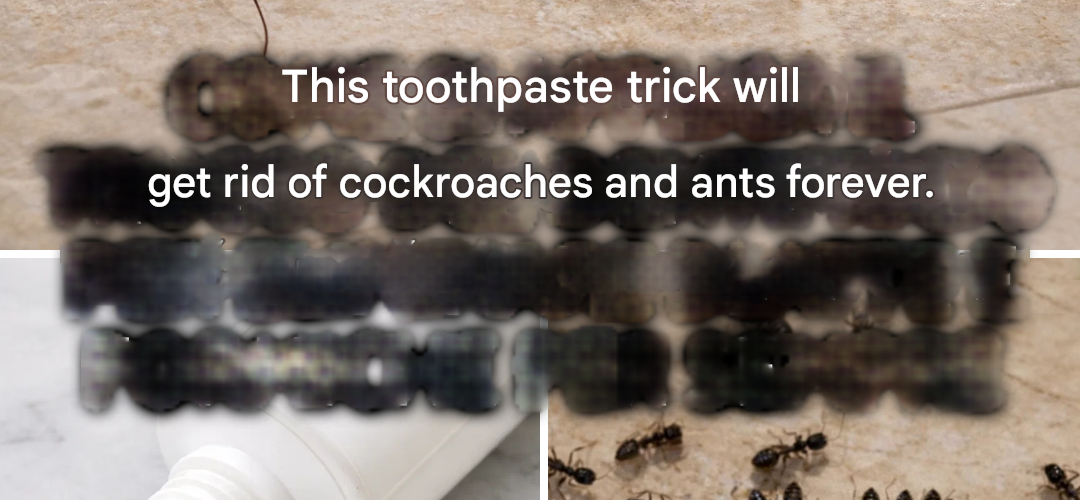
Even if simple and inexpensive “miracle tricks” sound tempting, you should critically examine them. The claim that toothpaste solves the ant and cockroach problem once and for all is unscientific and highly unlikely.
Here you’ll learn why it probably doesn’t work and what proven methods exist for insect control.
Why toothpaste isn’t a permanent solution:
Toothpaste is not an insecticide: Most conventional toothpastes do not contain ingredients that effectively kill ants or cockroaches. Some ingredients, such as menthol or fluoride (in high concentrations), can repel insects or have a mildly toxic effect, but not enough to wipe out an entire colony or nest.
Toothpaste is not an insecticide: Most conventional toothpastes do not contain ingredients that effectively kill ants or cockroaches. Insects can easily bypass toothpaste: Ants and cockroaches are clever creatures when it comes to finding food and avoiding danger. If you apply toothpaste to one spot, the insects will simply find another way in.
It only acts as a temporary barrier: Even if toothpaste repels insects, its effect is short-lived. The toothpaste dries out, loses its scent, and becomes ineffective. You would have to reapply it repeatedly for it to continue acting as a barrier.
It doesn’t address the root cause of the problem: The main issue with an insect infestation isn’t the presence of individual ants, but rather the presence of a nest or colony. Toothpaste on the surface won’t kill the queen or an entire nest hidden in a wall or under the floor.
What really works against ants and cockroaches:
To get rid of these insects, you need to combine preventative measures with targeted control methods:
Prevention is key:
Keep clean: Ants and cockroaches are searching for food and water. Remove crumbs, spills, and grease.
Store food properly: Keep food in airtight containers. Don’t leave dirty dishes in the sink.
Fix leaks: Eliminate water sources such as dripping faucets or leaking pipes.
Seale entry points: Check walls, windows, and doors for cracks and seal them with silicone or caulk.
Control methods:
Bait (traps): The most effective bait for ants is a bait that the ants carry back to the nest, thus wiping out the entire colony, including the queen. For cockroaches, there are gel baits or traps that attract and kill the insects.
Boric acid: This is a natural agent that is toxic to insects but relatively harmless to humans and animals when used correctly. It is applied as a powder to areas where insects are present. Handle boric acid with care and keep it out of reach of children and pets.
Diatomaceous earth: This fine powder made from fossilized algae with sharp edges mechanically dehydrates insects. It is non-toxic to humans and animals.
Professional pest control: In cases of severe infestation or if you are unable to control the pests yourself, it is advisable to hire a professional pest control company.
Conclusion: While the toothpaste trick may seem harmless, it is not very effective and certainly not a permanent solution. For a long-term solution to ant and cockroach problems, proven methods of prevention and control are essential.