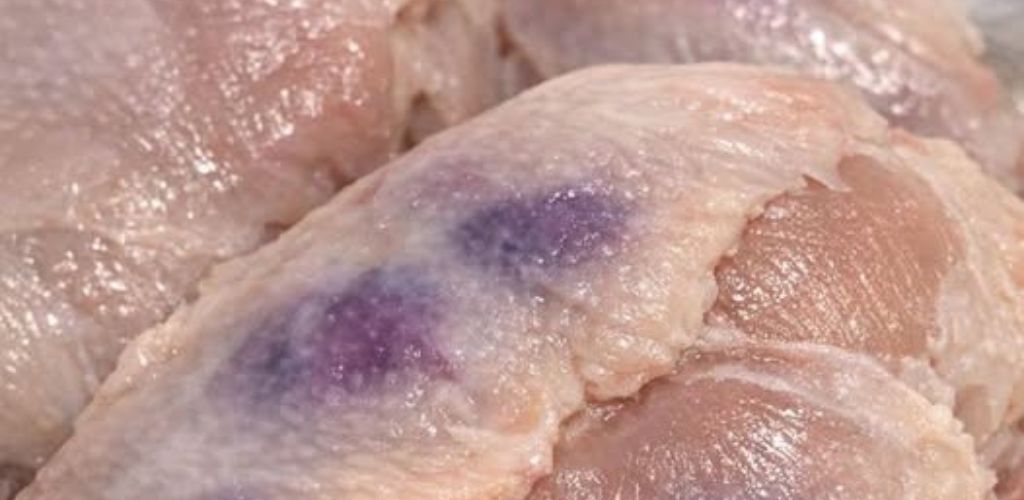
A purple spot on chicken might look alarming, but in most cases, it’s not a sign of spoilage. Here’s a quick guide to help you decide whether to cook the chicken breast or throw it away.
What’s likely?
If the meat is otherwise fine (see below), a purple or dark red spot is usually a bruise or a blood clot.
This is caused by a burst capillary during handling or processing.
After thawing, the spot may be more visible because ice crystals break down the tissue, allowing the pigment to dissolve more easily.
Bottom line: If it’s just mechanical damage, simply cut out the spot. The rest of the meat is safe. When should you absolutely throw meat away?
Even if it’s just a bruise, the meat may have been damaged during thawing. Perform these three tests:
Smell test: If the meat smells sweet, sour, or like ammonia, discard it immediately. Fresh chicken should smell neutral.
Touch test: If the chicken breast feels sticky or slimy (and the slime remains on your fingers even after rinsing), this indicates bacterial growth.
Appearance: If the meat has a gray or greenish tint (in addition to the purple spot), it is no longer fresh. Safe thawing
As a precaution: If the meat has been exposed for too long during thawing (e.g., left on a clothesline at room temperature all day), the risk of bacterial growth, such as Salmonella or Campylobacter, increases dramatically, regardless of the color of the spots.
Tip: If you don’t like the taste of the meat and it makes you feel disgusted, discard it. Your mind plays a big role in your eating, and an uneasy feeling can ruin your entire meal.
Does the meat feel normal, or is the surface unusually smooth?