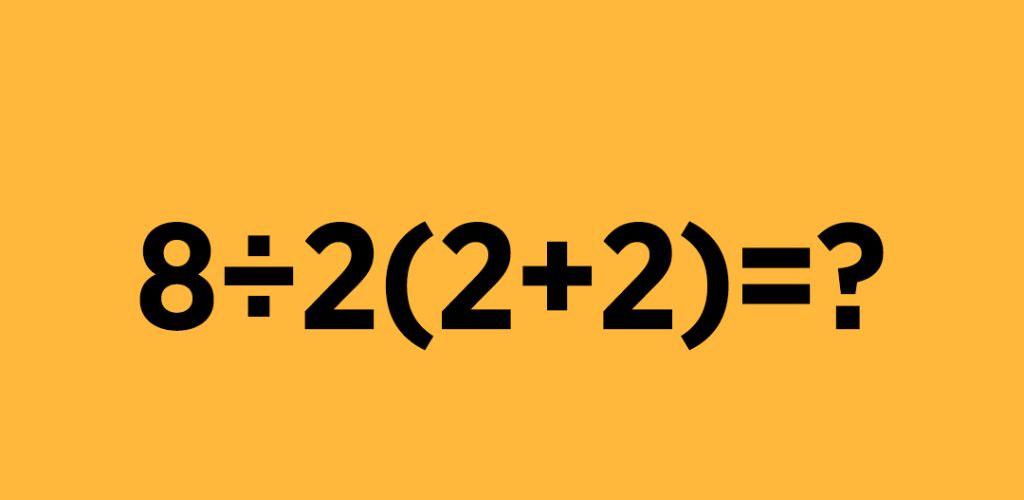
Welcome to the arena of online math disputes! When we talk about an example that can divide families and best friends, you probably have this famous notation in mind:
$$8 \div 2(2 + 2) = ?$$
This example regularly circulates on social media and causes utter chaos. Why? Because people are split into two irreconcilable camps, depending on which rules of arithmetic they apply.
Two approaches to the solution:
Everyone agrees on the first step: First, we solve the bracket $(2 + 2) = 4$. So the example changes to $8 \div 2 \times 4$. And this is where the argument begins:
Camp A (result = 16): They use the modern order of operations (multiplication and division before addition and subtraction). Multiplication and division have equal priority, so we calculate from left to right.
8 × 2 = 4
4 × 4 = 16
Camp B (Result = 1): They use older rules or consider the “implicit multiplication” (the number directly next to the parentheses) a stronger combination that should be calculated first.
2 × 4 = 8
8 × 8 = 1
Who is right? (My honest opinion): Purely mathematically and according to modern standards (which are also used by Google or WolframAlpha calculators), the correct result is 16.
However, as your friendly AI partner, I must add: The real error lies not in the mathematics, but in the incorrect notation. No mathematician would write it like that. They would either use a fraction bar or additional parentheses to clarify what is under what. This example is essentially a grammatically ambiguous sentence designed solely to provoke clicks and discussions in the comments.
Another example?
If not this one, perhaps you’re thinking of the fruit riddle (apple + banana × coconut) where the last line is missing a banana or half a coconut, which people don’t notice, leading to arguments about the answer.
Which example was it for you? Did you try to solve it in your head, or did you immediately reach for a calculator?