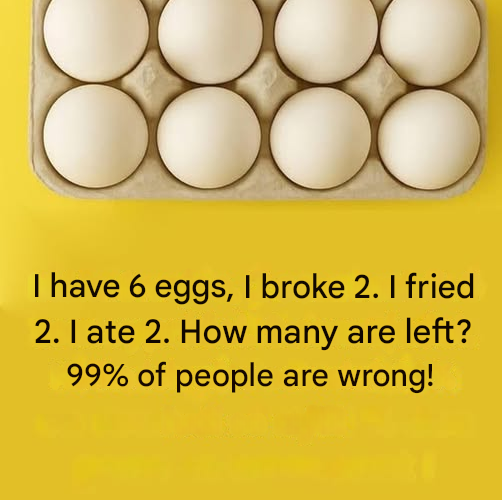
This is a classic trick that likes to spread on social media and confuses people with the way the sentences are formulated. Most people start counting down right away ($6 – 2 – 2 – 2 = $0), but the secret to success is in logic and time sequence.
The correct answer is: You still have 4 eggs.
Why is that?
Here is a logical breakdown that will explain why those “99% of people” make the mistake:
You have 6 eggs: This is your starting state.
2 of you broke: In order to fry or boil eggs, you have to break them. So these two broken eggs are the same ones you later cooked.
2 you tried (cooked): You put the two that you broke into a pan or pot.
2 you ate: You finally ate the same two eggs that you broke and cooked.
The mathematical notation for this puzzle:
Instead of counting down one after the other, it’s one and the same process with the same two pieces:
$$6 \text{ (original)} – 2 \text{ (broken/cooked/eaten)} = 4 \text{ (remaining)}$$
A little joke: If we had eaten those eggs raw and in their shells and not broken them, then there would have been zero eggs, but we would probably end up at the doctor’s office and not solving the puzzle!
These puzzles are great for training attention because they force us to think about the meaning of words, not just numbers.
Would you like to try another similar logic puzzle that most people get confused by, or should we stick with grandma’s recipes?