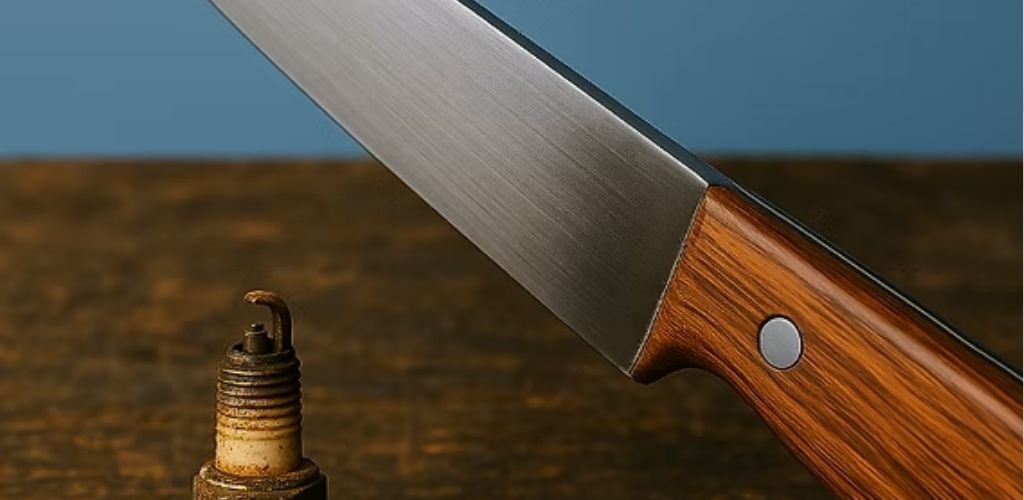
The white ceramic of a spark plug is made of aluminum oxide (Al₂O₃). This material is extremely hard (hardness 9 on the Mohs scale, just below diamond), withstands temperatures over 1000 °C, and is chemically inert. These properties make it ideal not only for spark plugs but also for whetstones, cutting discs, and high-quality sandpaper.
Why can you sharpen knives with a spark plug?
When you carefully run the edge of a knife over the ceramic, microscopic imperfections and burrs are removed. The cutting edge is smoothed and aligned, which improves cutting performance. In principle, it works similarly to a high-quality ceramic whetstone – only with a recycled everyday object.
…] Recommended Sharpening Angles for Different Knife Types
Knife Type Angle per Side Sharpness Durability Notes
Japanese Kitchen Knife 10°–15° 🔥 Very soft ❗ Fragile Ideal for sushi and fillets
Western Kitchen Knife 15°–20° ⚖️ Balanced 👍 Good compromise
Butcher’s Knife 20°–25° 💪 Robust 💯 Very sharp Cuts through bones and tendons
Survival/Tactical Knife 25°–30° 👊 Coarse 🛡️ Extremely sharp For frequent use
EDC Knife 18°–22° 🛠️ Versatile 👍 Long For everyday tasks
Note: The total angle is doubled. Example: 15° per side = 30° total.
How to Use a Spark Plug to Sharpen a Knife
Carefully break the spark plug (use gloves and a hammer).
Securely attach the ceramic piece to a stable surface.
Position the knife at the correct angle and draw it from the base to the tip.
Repeat the process 5-10 times per side with light pressure.
Then wipe the blade with a dry cloth.
This simple method transforms a seemingly useless piece of scrap into an effective sharpening tool.
In short: A secret weapon for mechanics and outdoor enthusiasts
Many people throw away old spark plugs – yet they contain valuable ceramic material that can be used as an improvised sharpening tool. With a little practice, you can achieve an almost surgically precise edge. This trick is well-known in workshops and survivalist circles and definitely belongs in your DIY toolbox.
Join our community!
Did you enjoy this tip? Then subscribe to our page, like us, and share the post with your friends. This way you’ll never miss any tips on knives, tools, and DIY ideas. Together we’re building a community for clever everyday solutions.