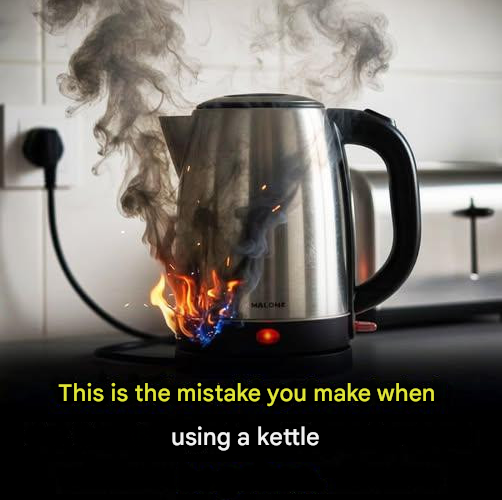
While the kettle is likely the hardest-working appliance in your kitchen, it’s also the most overlooked. We tend to think of it as “self-cleaning” because it boils water, but daily use can lead to a few hidden issues that affect both your health and your wallet.
Here are the most common pitfalls of daily kettle use:
1. The “Re-boiling” Trap
Many of us top up the leftover water from this morning to make a fresh cup. However, re-boiling the same water concentrates minerals and gases.
- The Issue: As water evaporates, the concentration of nitrates, arsenic, and fluoride can theoretically increase. While rarely dangerous in small amounts, it significantly flattens the taste of your tea or coffee because the dissolved oxygen is driven out.
- The Fix: Always use fresh, cold water. Use the leftover “old” water for your plants once it cools!
2. Limescale: The Silent Energy Thief
If you live in a hard-water area, calcium carbonate (limescale) builds up on the heating element.
- The Efficiency Loss: Limescale acts as an insulator. This means the element has to run longer and hotter to heat the water, which increases your electricity bill and shortens the lifespan of the appliance.
- The “Flake” Factor: Eventually, white flakes will end up in your drink. While not harmful to health, they aren’t exactly appetizing.
3. Nickel and Plastic Leaching
Not all kettles are created equal.
- Metal Kettles: In some older or lower-quality stainless steel kettles, the heating element can leach small amounts of nickel into the water, which can be an issue for those with specific allergies.
- Plastic Kettles: Constant boiling in plastic housing can lead to the leaching of microplastics or BPA/BPS.
- The Fix: If you are a heavy user, consider switching to a glass or high-grade borosilicate kettle with a concealed stainless steel bottom.
4. The “Minimum Fill” Fire Hazard
Modern kettles have “boil-dry” protection, but relying on it daily is a mistake. Boiling too little water puts immense thermal stress on the internal components, leading to premature circuit failure.
Quick Maintenance Guide
| Task | Frequency | Method |
| Descaling | Once a month | Boil 1:1 water and white vinegar, let sit for 30 mins, then rinse. |
| Emptying | Daily | Don’t leave water standing overnight; it encourages mineral buildup. |
| Exterior Wipe | Weekly | Keep the base dry to prevent electrical corrosion. |
Pro Tip: If you want the perfect cup of green tea or coffee, remember that boiling water ($100°C$) actually burns the leaves/beans. Many modern kettles allow you to set the temperature to $80°C$ or $90°C$—it’s better for the flavor and saves energy!
Would you like me to find a quick natural descaling “recipe” using lemon instead of vinegar to avoid that pungent smell?