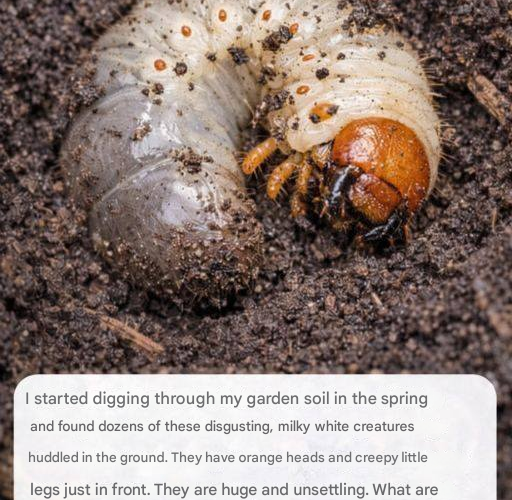
If, while digging in the garden, you found thick, milky-white larvae with brown-orange heads and small legs only in the front part of the garden, they are most likely the larvae of various beetles, such as:
Major
June
Garden beetle
Coleopard
These larvae live in the soil and usually curl into a C-shape when disturbed.
🌱 Why do they appear in the garden?
The larvae develop in the soil for several years. During this period, they feed primarily on plant roots, especially:
Lawn roots
Young vegetable and ornamental plants
Strawberries
Shrubs
If there are many larvae, plants may suddenly wilt or be easily uprooted because their roots have been damaged.
🔎 Are they always harmful?
Not necessarily. Some larvae, especially those of the rose beetle, are even beneficial, as they feed primarily on decaying plant material.
Key difference:
Harmful larvae → They usually live in the lawn or on the roots and feed on them.
Beneficial larvae (rose beetle) → They are more likely to be found in compost or humus-rich soil.
🛠️ What you can do
If you find a lot of them in your flowerbeds or on the lawn:
Collect them when digging. Attract birds (they like to eat the larvae). Use nematodes (biological pest control) in the soil. Check the lawn regularly.
💡 Fun fact: The larva can live in the soil for 3-4 years before pupating and eventually becoming a beetle.
💬 Full article in the comments 👇