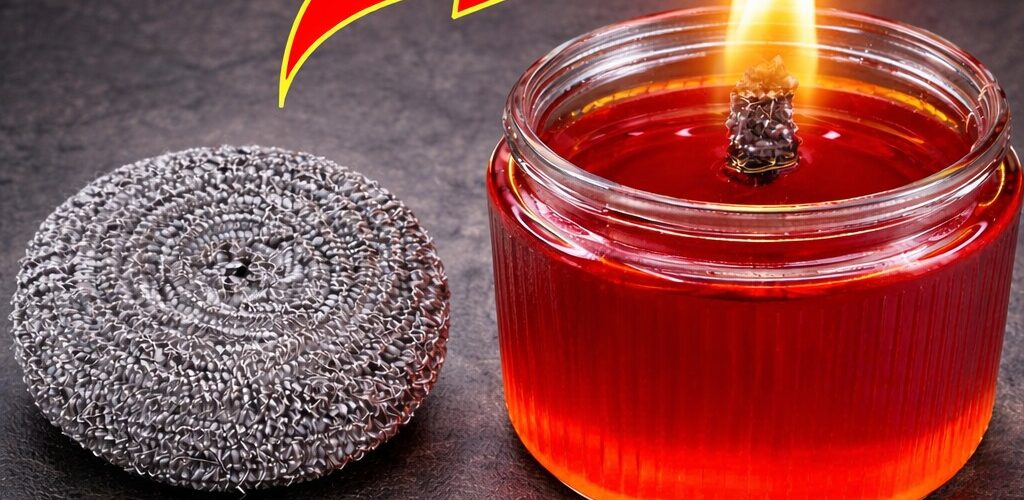
The concept of an “infinite wick” is widespread on the internet, but let’s be clear (or rather, clarify the matter): it’s not “free energy” in the sense of violating the laws of physics. It still requires fuel (oil) to burn. The trick is to use cheap vegetable oil instead of expensive wax and a wick that barely burns. It’s essentially a modern reinterpretation of old-fashioned oil lamps.
Here’s how to make an “infinite” wick at home for just a few cents:
What will you need?
A glass jar (for jam or decorative).
Water (makes up most of the volume).
Vegetable oil (sunflower or canola oil: this will be your fuel).
A plastic cap (from a PET bottle or a thin piece of plastic).
A piece of toilet paper or paper towel (this will be the wick).
Scissors and a nail/needle.
Making Procedure (Step by Step)
Wick Base: Cut the bottom of a plastic bottle or use a plastic cap. Poke a small hole in the center with a hot nail or needle.
Preparing the Wick: Tear off a small piece of toilet paper and roll it tightly into a thin cylinder (about 2-3 cm long).
Threading: Insert the wick into the plastic hole so that about 0.5 cm protrudes upward (this part will burn) and the rest faces downward.
Preparing the Container: * Pour water into the glass (about 3/4 full). You can add pebbles or food coloring for decoration.
Pour a layer of oil (about 1-2 cm) on the surface of the water. The oil will remain on the surface because it has a lower density than water.
Lighting: Place the plastic holder with the wick on the surface of the oil. Wait a moment for the wick to absorb the oil, then light it.
Why is it “infinite”?
The fuel is cheap: a liter of oil costs a fraction of a set of quality candles.
The wick doesn’t burn: because the paper is soaked in oil, it’s the oil vapor that burns, not the paper itself. Therefore, the wick burns very slowly.
Safety: If the glass container tips over, the water will immediately extinguish the flame.
⚠️ Important Notes
Odor: Pure vegetable oil may have a slight smell of French fries when burning. To avoid this, add a few drops of essential oil (lavender, lemon) to the oil.
Hygiene: Use only pure oil, not oil burned from a pan (it stinks and produces smoke).
Do not leave unattended: although safer than a regular candle, it is still an open flame.
Did you know that…?
A drop of liquid soap added to the water (before adding the oil) will help keep the water clean longer, preventing algae growth if you intend to keep this “candle” on display for an extended period.
Would you like to know how to use this principle to create a scent diffuser that also lights up?