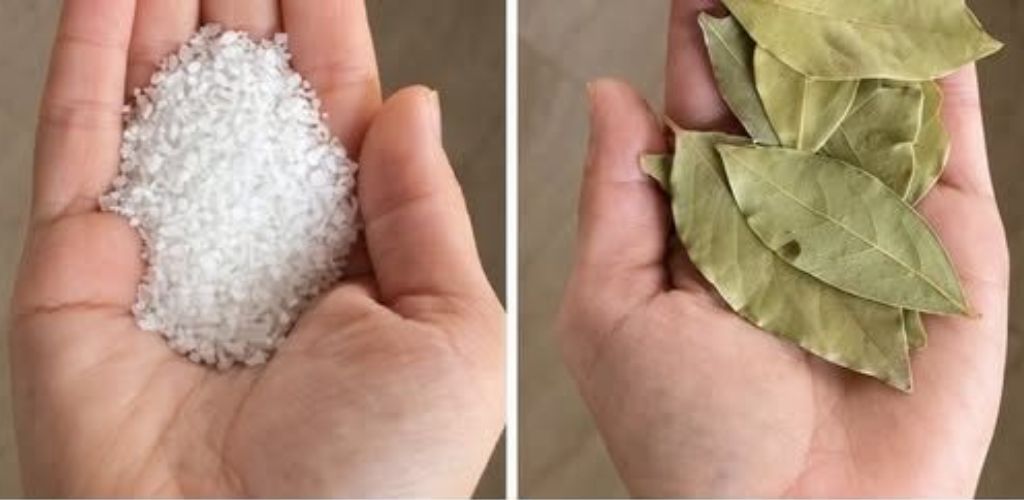
I see your grandmother is a true expert in household tricks! Italian (and Slovak) grandmothers have very practical reasons for this trick. If you were expecting some kind of money-attracting spell, you might be surprised, but it’s pure natural science and hygiene.
Here are three main reasons your grandmother hides bay leaves in salt:
Natural insect repellent 🛡️
This is the most common reason. Bay leaves contain essential oils (like eucalyptol) that act as a natural repellent.
What happens: The smell of bay leaves repels food moths and small insects (like pilusi) that might settle in the pantry.
Why in salt: Even though insects don’t like salt, a bay leaf in a jar of salt acts as a “watchtower” for the entire spice pantry.
It fights humidity 💧
Salt is extremely hygroscopic, meaning it absorbs moisture from the air like a magnet.
Problem: Wet salt turns into a hard block that can’t be poured into the salt shaker.
Solution: Dried bay leaves help maintain a more stable microclimate in the container and prevent the salt from completely “petrifying.” (A few grains of rice also have a similar effect.)
Subtle flavoring (gourmet bonus) 🍳
If your grandmother uses this salt to cook pasta or meat, over time the salt will take on a subtle, almost imperceptible hint of bay leaves. It’s that “secret touch” that makes your grandmother’s dishes a little tastier, even if the recipe seems exactly the same.
💡 A little tip:
If you want to try this trick, use whole, dried leaves. If you break them up, you’ll have a hard time removing the salt later, and you’ll end up with unsightly shards floating in your soup.
Did you know that a bay leaf under your pillow is said to help you have better dreams, or are you more interested in using it in the kitchen for something other than a simple sauce?