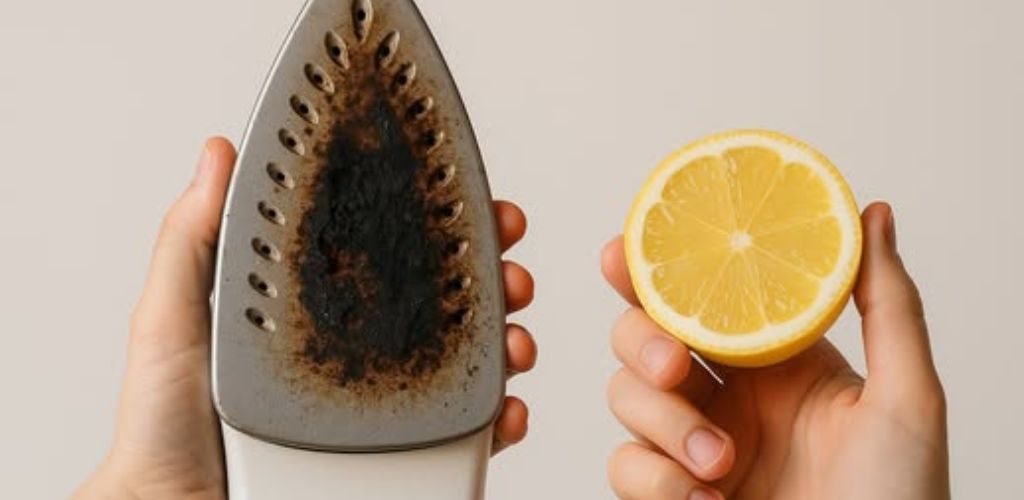
If you see a lemon icon 🍋 next to a post, it’s probably a trick to remove burnt-on and limescale from your ironing board. Lemon juice is a natural acid that can work wonders with mineral deposits and baked-on fibers.
Here’s how to perform this “lemon cure” safely and effectively so that your iron glides over the fabric like new again.
🍋 Lemon trick for burnt-on iron
This procedure is ideal if you have brownish spots on your ironing board or if your iron is starting to “scrub”.
What you’ll need:
1 lemon (halved).
Table salt (preferably fine).
An old cotton cloth.
Procedure:
Preparing the “peeling”: Sprinkle a generous layer of salt on the cut side of the lemon. The salt combined with the acid creates a fine abrasive paste that will not scratch stainless steel or ceramics.
Scrubbing (cold): With the iron turned off and cold, move the lemon and salt in circular motions. Press down to release the juice, which will begin to dissolve the burnt-on residue.
Finishing with a cloth: Place the cloth on a flat surface and “iron” it with lemon juice and salt.
Final cleaning: Wipe the surface with a damp, clean cloth and make sure that there is no salt or pieces of pulp left in the steam holes.
💨 How to clean the inside (steam holes)?
If your iron is “spitting” white pieces of scale, lemon on the surface will not be enough. Citric acid will help here:
Mix 2 teaspoons of citric acid with 200 ml of water.
Pour the solution into the tank, turn on the iron to maximum and let it steam well over the sink (use the “steam boost” function).
Then rinse the tank with clean distilled water.
📊 Comparison of cleaning methods
Method What is it best for? Risk
Lemon + Salt Common burns, shine restoration. Minimal.
Toothpaste Fine scratches and dull surface. Must be wiped out of the holes properly.
Paracetamol (tablet) Black, heavily burnt plastic on the surface. Smell! Must be done with a hot iron.
💡 A little advice from a “peer”:
Although lemon smells great and cleans wonderfully, never use coarse sea salt on Teflon surfaces of irons. You could damage the non-stick coating. For Teflon, only use lemon juice applied to a soft sponge.
Prevention tip: To keep your iron looking “like new” for as long as possible, use a 1:1 mixture of tap water and distilled water (unless the manufacturer specifies otherwise). Pure distilled water can be too aggressive for some older models and, paradoxically, cause corrosion inside.
Would you like to know how to remove a burnt piece of synthetic fabric that has stuck to your iron and won’t come off?