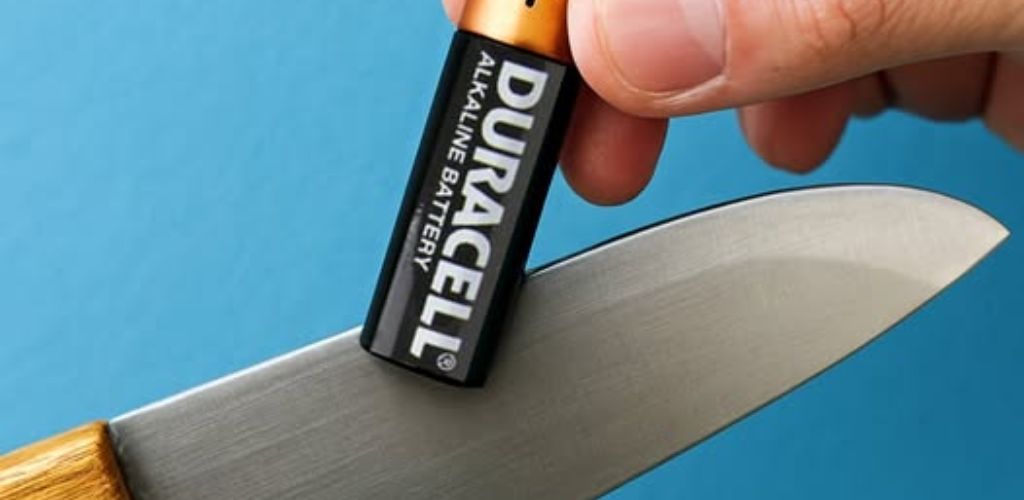
Forget about expensive electric sharpeners that unnecessarily remove millimeters of steel from your knives. Experts, especially chefs and butchers, know that the key to razor-sharpness is not brute force, but the right angle and one item you have in your kitchen right now.
Secret Revealed: The Ceramic-Bottom Trick
If you don’t have a professional sharpening stone on hand, the best and fastest tool is a regular ceramic mug.
Turn the mug over: Use the bottom of the mug, specifically the rough, unglazed ring on the bottom. Ceramic is harder than steel, so it acts as a gentle sharpening stone.
Correct angle (Key to success): Place the knife at a 15° to 20° angle to the edge.
Hint: If you can’t imagine 20°, it’s about half of a right angle.
Smooth motion: Pull the blade towards you (from the handle to the tip), as if you were cutting a thin slice from a mug. Repeat 5 to 10 times on each side.
Why do knives go dull right away? (Mistakes you’re making)
Even the best knife will go bad in a matter of days if you do these three things:
Mistake What’s happening to the knife Better solution
Dishwasher Hot water and salt dull the blade and destroy the handle. Wash knives by hand in cold/lukewarm water only.
Cutting on glass/stone The hard surface will instantly bend the delicate micro-edge of the blade. Use only wooden or soft plastic boards.
Drawer storage Knives bang against each other and dull each other. Use a magnetic strip or wooden block.
How do you know if a knife is really sharp?
Experts don’t use the thumb test (it’s dangerous). Try the newspaper test:
Hold a sheet of paper loosely in the air with one hand.
Try cutting it from top to bottom with the knife.
A sharp knife will cut through the paper cleanly, without tearing or bending the paper.
💡 Pro Tip: Leather Belt Trick
To get the edge to absolute perfection (really razor-sharp), after sharpening on a mug, “stropping” the knife on the back of a leather belt several times (away from the blade). This process is called stropping and will remove even the smallest metal filings (needles) that may be left on the edge.
Would you like me to explain how to make a homemade sharpening paste that will give your knives a mirror-like shine?