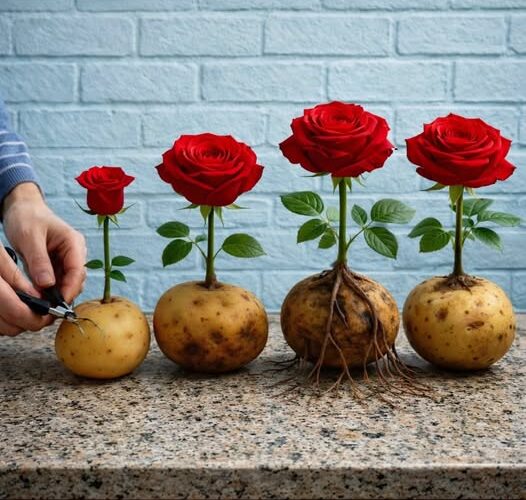
Ah, the classic “rose in a potato” trick! It’s one of the most viral content in the DIY gardening world. If you’ve seen those videos where a flowering bush magically appears after a few days, I have to give you a small (but friendly) disappointment: it’s not quite that simple.
However, there’s a certain botanical logic behind this practice. Here’s what really happens and why the results are often surprising (sometimes positively, sometimes less so).
The theory behind the trick
The idea is to use the potato as a natural incubator for a rose cutting (a cut sprig).
Constant humidity: The potato is about 80% water and should provide the sprig with the necessary hydration without rotting.
Nutrients: It’s thought that the starches and nutrients in the tuber nourish the rose as it tries to develop roots.
The Facts
Although the theory is appealing, “experienced gardeners” know there are risks:
Rot Risk: The potato often rots before the rose has established roots, transmitting bacteria and fungi to the cutting.
Competition: The potato is a living tuber. Often, the potato sprouts instead of the rose! You’ll end up with a beautiful potato plant with a dry rose sprig in the middle.
How to Do It Correctly (To Maximize Your Odds)
If you want to try the experiment, don’t just stick the branch into the tuber. Follow these “pro” steps:
Prepare the cutting: Take a young (but not too green) branch about 20 cm long. Remove the flowers and most of the leaves.
45° cut: Cut the base of the rose diagonally and dip it in a little rooting hormone (or honey, which has antibacterial properties).
Punch the potato: Poke a hole in the potato with a clean screwdriver, so as not to force the branch.
Plant it all in the ground: Don’t leave the potato exposed to the elements! Place it in a pot with good-quality potting soil, covering the potato completely.
Greenhouse effect: Cover the cutting with a cut-up plastic bottle to maintain constant humidity.
The verdict
Does it work? Yes, sometimes. It’s a fun way to recycle scraps, but for the most valuable roses, gardeners still prefer the classic cutting in sand and peat or directly in water.
Would you like to know which rose varieties are easiest to root with this method, or would you prefer a recipe for a natural homemade “rooting hormone”?