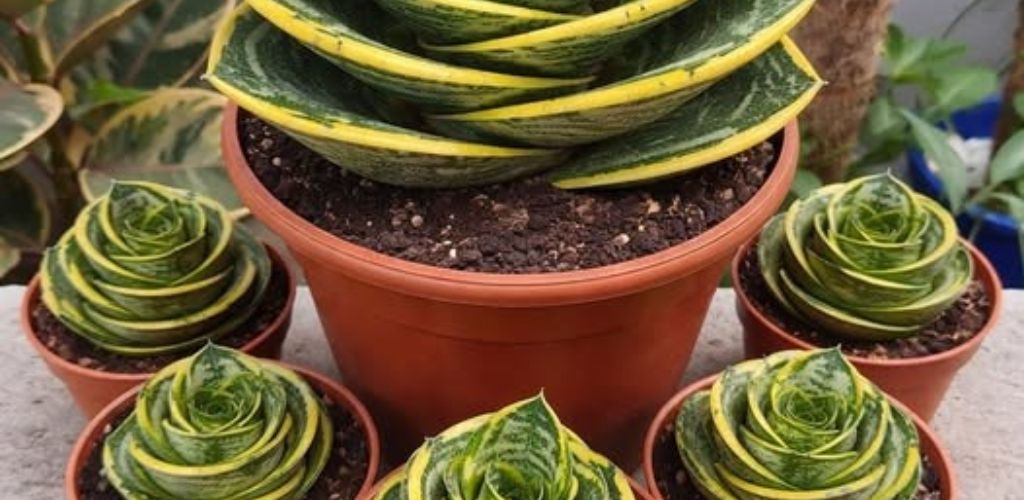
This trick involves one of the most popular houseplants ever – Sansevieria (mother-in-law’s tongue in Czech, mother-in-law’s tongue in Slovak). Most people know it as a bunch of long vertical leaves, but with the help of a “transplanting trick” you can turn it into an elegant, symmetrical sculptural rosette that resembles a blooming lotus.
It’s not magic, but about taking advantage of the way these plants reproduce and how they can be shaped when transplanted.
✨ What is the “magic”?
The secret lies in separating the leaf rosettes and planting them deep, at an angle. Mother-in-law’s tongue grows from rhizomes. When you pull it out of the pot, you will find that the leaves are often crowded together in chaos.
Steps to create a rosette:
Dividing the clump: Remove the plant and carefully separate the individual rosettes (groups of leaves that grow from the same spot on the rhizome).
Cleaning: Remove old, dry or damaged leaves so that only healthy “hearts” remain.
Angle shaping: Instead of planting the rosette vertically upwards, plant it in the centre of a new, smaller, designer pot so that the lower leaves spread out slightly to the sides.
Fixing with substrate: Use a permeable substrate for cacti and succulents and anchor the leaves firmly with it. The pressure of the soil will keep the leaves in their new, spreading star shape.
🎨 Why does it look so good?
Geometry: You will emphasize the natural structure of the leaves and their pattern.
Minimalism: A single rosette in a beautiful pot looks much more modern than an overgrown and dense pot full of leaves that fall over each other.
Slow growth: Sansevieria grows slowly, so it will maintain this “sculptural” shape for a very long time without the need for further intervention.
💡 Tip for a “pro” look
If you want your rosette to look like it came from the cover of a housing magazine, cover the surface of the substrate with decorative pebbles or lava rock. Not only does it look great, but the stones also help to hold the leaves at the desired angle until the plant takes root properly.
A small warning: Although Sansevieria survives almost everything, it does not like to be overwatered. The deeper you plant it, the more careful you have to be with watering so that the heart of the rosette does not start to rot.
Do you have the classic tall variety (Sansevieria trifasciata) at home, or the smaller rosette-shaped (Hahnii), which is the best for this trick? If you want, I can also advise you on how to grow dozens of leaves from one leaf!