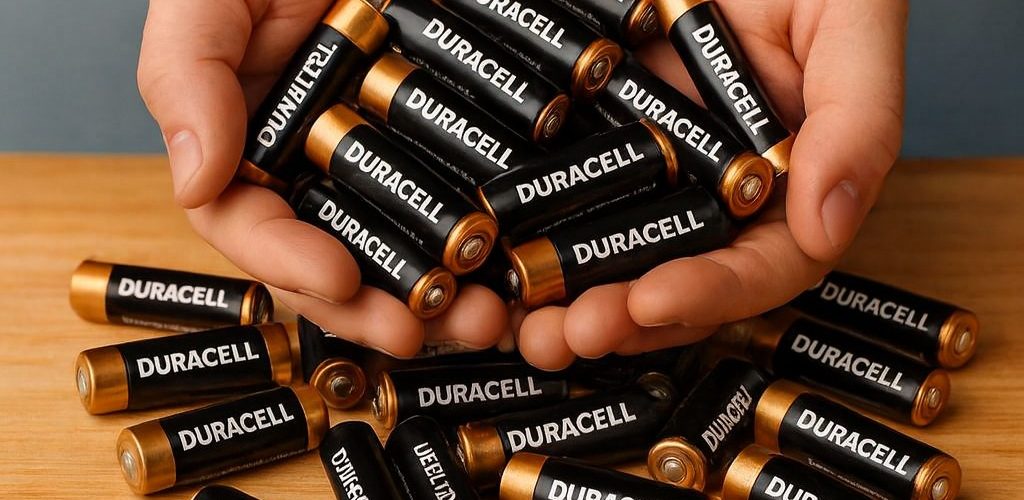
Headlines about “manufacturer secrets” regarding batteries are often misleading, but there’s a technical reality that the average consumer isn’t aware of. This is especially true for classic alkaline batteries (AA or AAA), which we usually throw away.
Here’s what’s really going on inside and how you can use a “dead” battery:
The secret of residual energy
When the remote control or children’s toy stops working, the battery isn’t completely empty.
How it works: Many devices have a so-called “voltage threshold.” When the battery voltage drops, for example, from 1.5 V to 1.1 V, the device shuts down and indicates that the battery is low.
Reality: However, there’s still 10-20% of energy left in the battery, which doesn’t have enough “pressure” (voltage) to power energy-hungry electronic devices.
The “Revitalization” Trick for Low-End Devices
Batteries that no longer work in a digital camera or game console will likely work for several months in:
Wall clocks
Thermometers
Remote controls (if they didn’t have batteries before)
Energy-efficient LED flashlights
The Physical Trick: Heat and “Massage”
You may have seen your grandparents rubbing batteries between their hands or gently tapping them.
The science behind it all: chemical reactions inside the battery create barriers (gas bubbles or crystals) that block the flow of current. By heating or applying gentle mechanical pressure, these barriers can be broken, giving the battery a “final shot” of energy to complete its work.
⚠️ Beware of dangerous myths!
Myth Truth
Charging alkaline batteries DANGEROUS! Regular alkaline batteries are not designed to be charged. They can leak or explode in the charger. Put them in the freezer. Cold temperatures slow the chemical reaction, which is helpful for preserving new batteries, but it won’t revive a “dead” battery.
Boiling batteries: absolutely out of the question. There’s a risk of releasing toxic substances and exploding.
What to do with truly dead batteries?
If the battery doesn’t react even after hours, it’s time to recycle it.
Why not just throw them in the trash? Batteries contain heavy metals (zinc, manganese, sometimes cadmium). When they end up in landfills, the packaging corrodes, and these substances poison the soil and groundwater. However, the metals can be recovered at recycling centers to make new products.
💡 My final tip:
Invest in rechargeable NiMH batteries (e.g., Eneloop). They have a lower self-discharge rate and will replace hundreds of disposable batteries, saving you money and protecting the planet.
Would you like to know how to use a simple multimeter or a simple “bounce test” to determine if a battery is still usable?