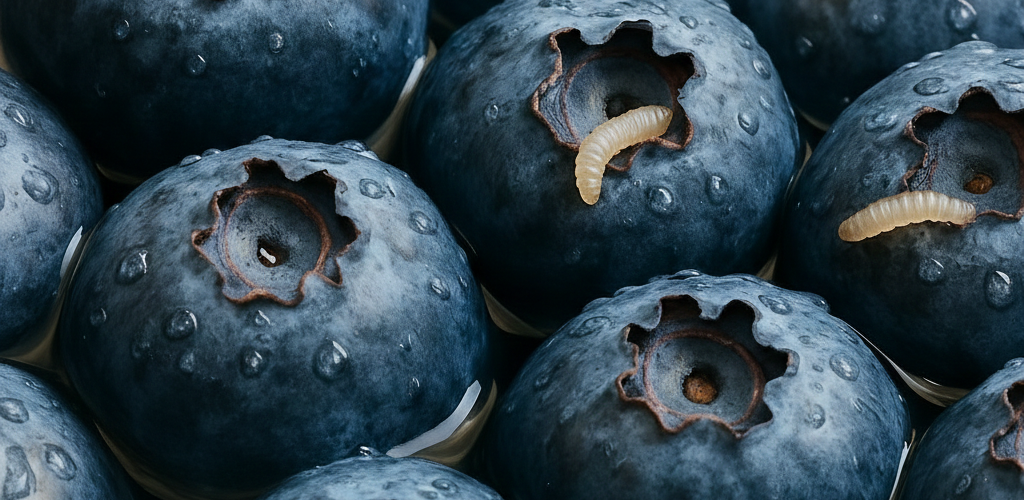
Blueberries are considered a “superfood,” but their quality degrades very quickly after harvest. That secret that “very few people know” isn’t just about mold or size, but a fundamental visual detail called bloom.
Here’s what you absolutely must check before putting your basket in your cart:
- The “Bloom” (The White Powder) ❄️
If you see a light, opaque, almost white or grayish coating on the surface of the blueberries, buy them immediately.
What it is: It’s a natural wax produced by the fruit itself to protect itself from the sun and insects.
What it indicates: The presence of bloom is the unmistakable sign of freshness. The more the blueberry is handled or ages, the more the bloom disappears, leaving the fruit shiny and dark. A blueberry that’s too shiny is an old or over-handled blueberry.
- The color of the “stem” (the attachment) 📍
Look at the point where the blueberry was attached to the plant:
If it is red or greenish: The blueberry was picked too early. Unlike bananas, blueberries don’t ripen once picked. They will be sour and hard.
If it is dark blue/black: It is perfect and very sweet.
- The “Dry Basket” Test 🧺
Lift the basket and look at the bottom:
If you see juice stains on the paper or plastic, it means the fruit at the bottom is squashed or, worse, that fermentation has begun.
Just one broken blueberry can rot the entire container within 24 hours due to mold.
How to store them to make them last twice as long?
If you bought them and want to prevent them from going soft after two days, follow this table:
Action Why do it?
DO NOT wash them immediately. Humidity accelerates mold. Wash them just before eating.
Vinegar and water: If you want to disinfect them, use a solution of 3 parts water and 1 part vinegar, then dry them thoroughly.
Breathable container: Place them in the refrigerator in a container with paper towels on the bottom to trap moisture.
The “Floating Blueberry” trick 💧
If you’ve had blueberries in the refrigerator for a while and aren’t sure if they’re still good: place them in a bowl of water.
The ones that sink are still firm and high in sugar.
The ones that float may be slightly floury or old (but still edible if they’re not moldy).
One last tip: Avoid giant blueberries if you’re looking for flavor. Often, the smaller ones (wild or semi-wild varieties) have a higher concentration of antioxidants and a much more intense flavor than the huge “display” ones.
Have you ever found mold in the bin you just got home, or want to know how to freeze them properly for your smoothies?