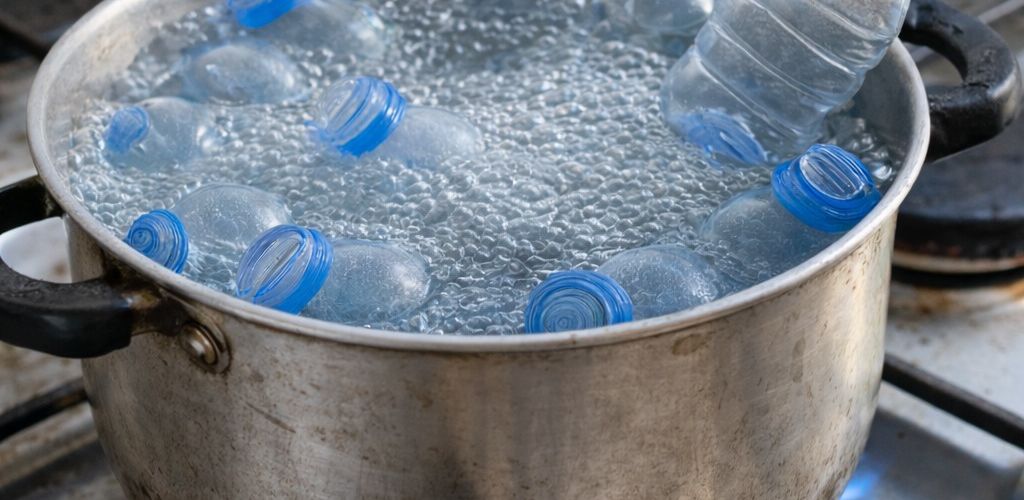
We often see this type of headline on the Internet as “guaranteed tricks from experts”, but in the case of plastic bottles and boiling water, you need to be very careful. It’s not just about creativity, but also about chemistry and safety.
Let’s take a look at what actually happens to a bottle (most often PET material) when boiled and whether it makes sense.
What happens when it comes into contact with boiling water?
Plastic bottles are made of polyethylene terephthalate (PET). This material has a low softening point (around $70^\circ\text{C}$):
Shape memory (Shrinkage): If you pour boiling water ($100^\circ\text{C}$) into a PET bottle, the bottle will immediately begin to deform and “shrink”. The plastic will return to its pre-blow-mold state.
Substance release: At high temperatures, PET plastic can release microplastics or chemical compounds (e.g. antimony) into the water that are not intended for consumption.
Material thickening: After boiling and then cooling, the plastic hardens and thickens.
What “miracle” could an expert reveal to you?
There are several practical (but also bizarre) ways to use this effect, but always for decorative or technical purposes, never for food:
Sturdy connecting rings: If you boil just a strip cut from a bottle around two pieces of wood, the plastic will contract so strongly that it creates a joint as strong as a metal clamp.
Shaping storage boxes: By briefly dipping the edges of the cut bottle in hot water, you can “pull” them inward, so they are not sharp and you can use the bottle as a pen or tool holder without the risk of cutting yourself.
Making plastic “ropes”: If you cut a bottle into a long, thin strip and then heat it (e.g. with a heat gun or boiling water), the strip will turn into an extremely strong plastic string that can hold tens of kilograms.
Warning about “Internet recipes”
Caution: There are videos circulating on social media where people use boiled bottles as molds to cook ham or eggs. Never do this! Regular bottles are not designed for heat treatment of food and you risk contaminating the food with toxins.
What should you do with the bottles?
If you don’t want to just throw them away in the recycling bin, try this:
Self-watering flower pots: Cut off the top third, turn it upside down and add a wick.
Workshop organizer: The transparent bottoms of bottles are ideal for nails and screws.
Were you interested in this trick more for recycling in the garden, or were you looking for a way to make something practical for the home?