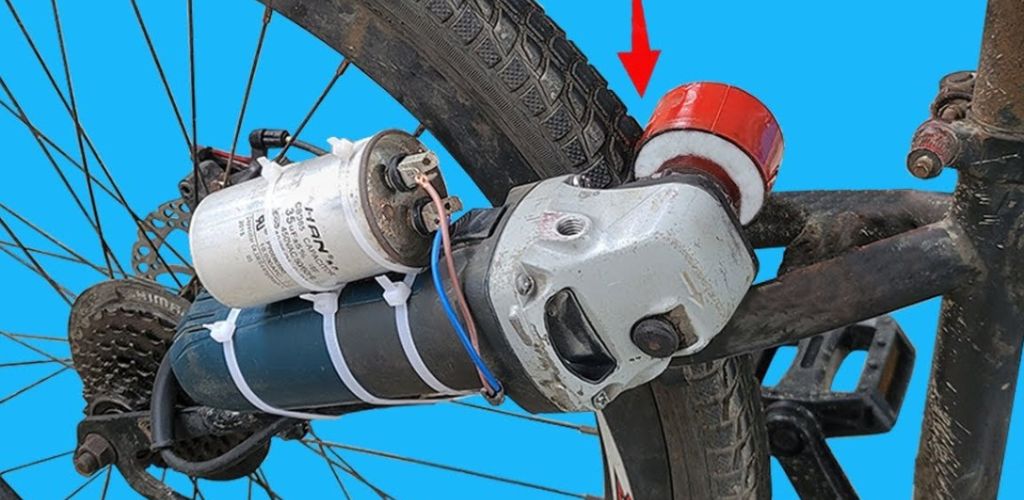
Rural innovations can sometimes be surprising and creative, but the idea of attaching an angle grinder to a bicycle to turn it into an e-bike is extremely dangerous and impractical for several reasons.
Why the angle grinder idea is dangerous
Low power and incorrect speed: An angle grinder is designed for high speeds and high torque at light loads for cutting or grinding materials. It is not designed to provide continuous power at low speeds and high torque, as an electric bicycle motor should. The motor would quickly overheat and be damaged.
Lack of control and adjustment: An angle grinder typically has only an on/off switch and no speed control via a throttle or sensor, as is common with e-bikes. This would mean the bicycle would operate at full power or not at all, which is extremely difficult to control.
Safety risk due to rotating parts: The rotating disc or gear of the angle grinder is exposed and could pose a significant risk of injury if it came into contact with clothing, body parts, or foreign objects.
Poor power transmission: Transmitting power from an angle grinder to a bicycle wheel is extremely inefficient and dangerous. There would be no adequate chain or belt to reliably transmit torque. Direct contact with the tire would cause excessive wear and poor traction.
Instability and weight: An angle grinder is not designed to be used as a bicycle propulsion system. It would likely subject the bicycle to uneven stress and make it unstable, potentially causing a fall. The weight of the device and the required battery would also be considerable.
Legal Issues: A bicycle modified in this way would likely not comply with bicycle or e-bike safety regulations and would be illegal to use on public roads.
What’s behind these videos?
These videos or ideas circulating on the internet are often:
Experiments: They often demonstrate how some form of propulsion is technically possible, but not how safe or practical it is. They are rarely intended for real-world use.
Attention-grabbing: These unconventional solutions attract attention and generate clicks because they are so unusual.
Dangerous Imitations: The problem is that such videos can encourage imitation, which can lead to serious accidents.
How to Safely Convert a Bicycle into an E-Bike
If you want to convert a regular bicycle into an e-bike, safe and dedicated conversion kits are available. These kits include:
A suitable electric motor: This can be a hub motor (in the front or rear wheel) or a mid-drive motor (in the bottom bracket).
A suitable battery: Safely housed in a housing.
A controller: to control the motor and power output.
Sensors: for pedal assist or a throttle.
A display: to show speed, battery status, etc.
These kits are designed to be safe, transfer power efficiently, and comply with legal regulations for e-bikes.
Conclusion:
Although a farmer’s idea of using an angle grinder to power a bicycle may seem creative, it is an extremely dangerous and inefficient approach. E-bike conversions must always be performed with appropriate, safe components and in compliance with safety regulations. The risks of using an angle grinder far outweigh the potential benefits.
Have you heard of other unusual conversion projects that you found fascinating or potentially dangerous?