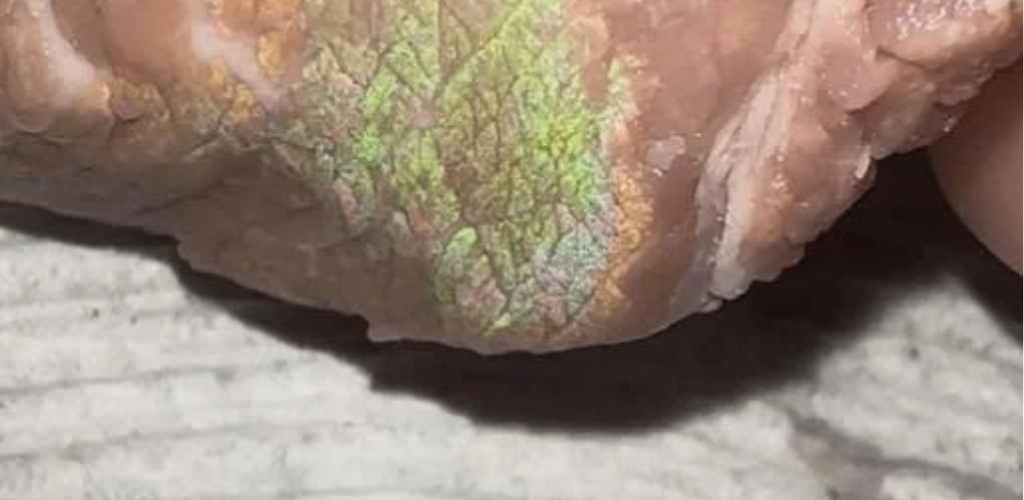
You slice open a fresh package of roast beef for your lunch sandwich… and suddenly, wow! The meat glistens like an oil slick or a soap bubble, flashing shades of green, purple, and blue under the kitchen light. You might momentarily panic: “Is it rotten? Did I buy radioactive cold cuts?”
Don’t worry. The iridescent glow in cold cuts isn’t a sign of spoilage, contamination, or foreign interference—it’s a fascinating (and 100% harmless) optical phenomenon based on physics, not food safety.
In fact, seeing this iridescent effect usually means the meat is fresh, properly aged, and perfectly cut. Let’s break down the science behind this colorful culinary illusion and why you can eat this roast beef with complete confidence.
The real reason meat sparkles: it’s all about light and structure. The rainbow effect, scientifically known as iridescence, has nothing to do with bacteria, dyes, or spoiled meat. Instead, it’s caused by the interaction of light and the microscopic structure of the meat.
Here’s how it works:
🔬 Meat is made up of tightly packed muscle fibers. Muscle tissue isn’t smooth, but rather bundles of long, parallel protein fibers (like tiny biological cables). When meat is cooked or aged (as in most sausages), these fibers contract and align even more tightly.
🔪 Cutting creates a natural “diffraction grating.”
When the slicer cuts perpendicular to these fibers (a technique called “cutting against the grain”), it cuts the packages cleanly, leaving behind a surface covered in microscopic grooves, almost like the ridges on a CD or DVD.
💡 Light reflects off these grooves, creating rainbows.
When light hits this grooved surface, it bends and scatters in different directions, a process called diffraction. Different wavelengths (colors) of light are reflected at slightly different angles, breaking up white light into its constituent colors, just like a prism.
✅ This is exactly the physics that creates rainbows in soap bubbles, oil slicks, and peacock feathers!
🥩 Which meats are most likely to show this effect? Not all meats are iridescent, but iridescence is often seen in:
Roast beef (most common, due to its dense, even fiber structure)
Corn beef
Pastrami
Lean, cooked sausage with visible grains
Less likely in:
Ground meats (fibers crumble)
Fatty meats (fat scatters light randomly, obscuring iridescence)
Raw meat (fibers are not as rigid or aligned)
Interesting fact: The effect is most intense in bright, direct light, such as LED kitchen lights or sunlight. In low light? You might miss it completely.
🚫 When rainbow-colored meat IS a problem (Rare, but important!)
While iridescence is almost always safe, there are rare cases where colored meat indicates spoilage. Here’s how to tell the difference:
Safe iridescence vs. Warning Signs of Spoilage
✅ Brightness varies depending on viewing angle (like a CD) ❌ Uniform, dull green, gray, or black hue
✅ Only on the surface of cooked/aged meat ❌ Slimy or sticky texture
✅ No unpleasant odors ❌ Sour, ammonia-like, or “rotten” odor
✅ Hard, normal texture ❌ Excessive fluid, swelling, or mold
⚠️ Trust your senses: If meat smells unpleasant, feels slimy, or looks dull and discolored regardless of lighting, throw it out.
🥪 Why is this important for your sandwich (and your peace of mind)?
Understanding this phenomenon isn’t just trivial: it helps you avoid food waste and eat with confidence. Millions of perfectly good pieces of meat are thrown away every year simply because people mistake shine for spoilage.
So next time your roast beef sparkles like a disco ball, celebrate physics, not fear.
🔬 Bonus: Can you prevent the rainbow effect?
Not really, and you don’t have to! But if it bothers you:
Choose thicker cuts (less uniform surface = less diffraction)
Choose fattier meats (fat changes the fiber pattern)
Store meat in low-oxygen containers (vacuum-sealed or wrapped in paper towels)
Really? Most chefs and food scientists consider it a sign of the cut quality and freshness of the product.
Final Thought: Nature’s Light Show on Your Dinner Plate
The rainbow effect you see on your cold cuts is not a mistake: it’s a small, edible demonstration of wave optics going on in your kitchen. Proof that…