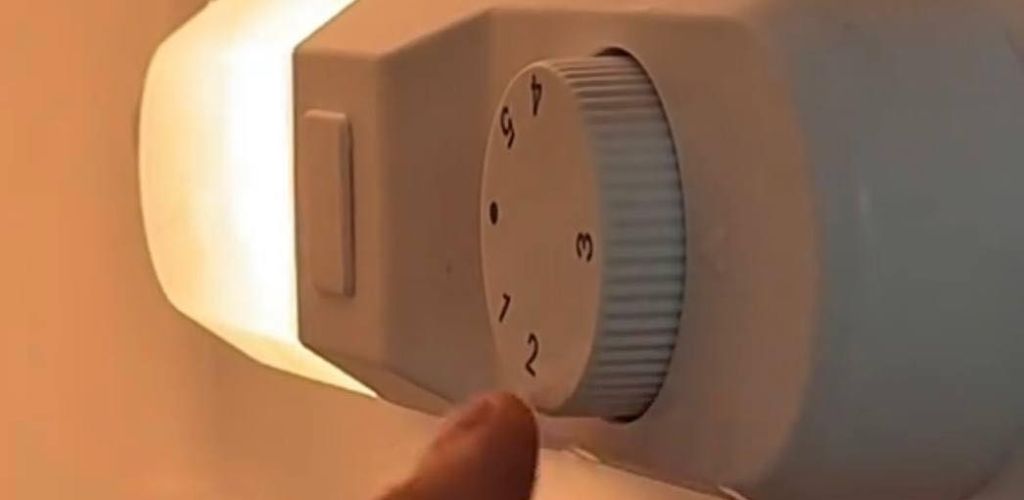
That’s a fantastic observation! It’s true that the numbers on a classic refrigerator dial often don’t directly correspond to degrees Celsius ($^\circ\text{C}$).
You are correct: the numbers are not the temperature.
What the Numbers on the Refrigerator Dial Actually Mean
The numbers (usually 1 to 5, 1 to 7, or similar) represent the power level or intensity of the cooling cycle, not a specific temperature in degrees.
- Low Number (e.g., 1 or 2): This is the warmest setting. The fridge cools with the least intensity, meaning it runs for shorter periods.
- High Number (e.g., 5, 6, or 7): This is the coldest setting. The fridge cools with the highest intensity, meaning it runs for longer periods to drop the temperature significantly.
The Ideal Setting
For most fridges and optimal food safety/energy efficiency, the actual recommended temperature in the middle shelf is around $+5\,^\circ\text{C}$ to $+7\,^\circ\text{C}$.
To achieve this:
- Start with a medium setting on the dial (e.g., 3 or 4 out of 5 or 7).
- Use a separate fridge thermometer (which costs just a few dollars) and place it in a glass of water on the middle shelf.
- Check the temperature after a few hours. If it’s too warm, turn the dial up one number. If it’s too cold (below $+5\,^\circ\text{C}$), turn the dial down one number.
This difference is why it can be so confusing! Since the actual temperature inside the fridge is affected by the room temperature, how full the fridge is, and how often the door is opened, manufacturers use an intensity scale instead of a fixed temperature value.