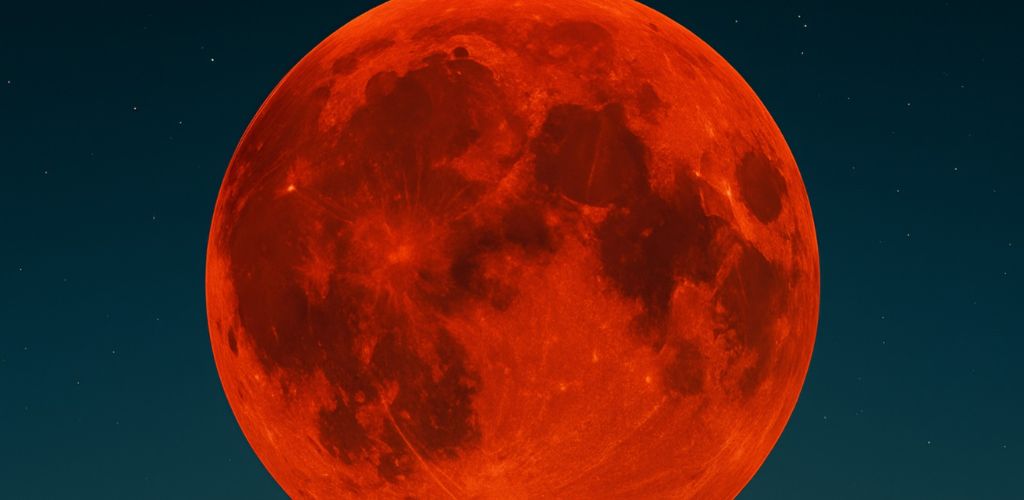
Thank you for bringing this special celestial event to our attention! The total lunar eclipse on September 7, 2025 promises to be a truly stunning spectacle.
Here are the most important information about this event and why the Moon turns red.
What to expect on September 7, 2025?
During a total lunar eclipse, the Earth is directly between the Sun and the Moon. This puts the Moon in the Earth’s shadow, blocking direct sunlight.
The solar eclipse on September 7, 2025 will be visible to observers in Europe, Asia, Africa, and Australia. In many parts of Europe, including Germany, a total lunar eclipse will be visible in the evening sky shortly after moonrise.
Totality, the phase in which the Moon is completely in the Earth’s shadow and takes on a reddish hue, will begin at 19:30 (CEST) and end at 20:53 (CEST). The eclipse will reach its maximum at 20:12 (CEST).
Why does the Moon turn red? The mystery of the “blood moon”
Although the Moon enters the Earth’s shadow, it does not disappear completely. It takes on a stunning, reddish-copper hue. This phenomenon is due to the Earth’s atmosphere.
Scattering: The Earth’s atmosphere acts as a lens, refracting sunlight. Short-wavelength light (blue and violet light) is scattered by the atmosphere, which is why the sky appears blue during the day.
Red light passes through: Long-wavelength light (red and orange light) penetrates the atmosphere more easily. This red light is bent into the Earth’s shadow and illuminates the Moon.
The color: The Moon reflects this bent red light, which is why it appears to us as a “blood moon.”
The more dust, smoke, and particles in the atmosphere, the darker and redder the Moon may appear.
The next total lunar eclipse after September 2025 will be on March 3, 2026.