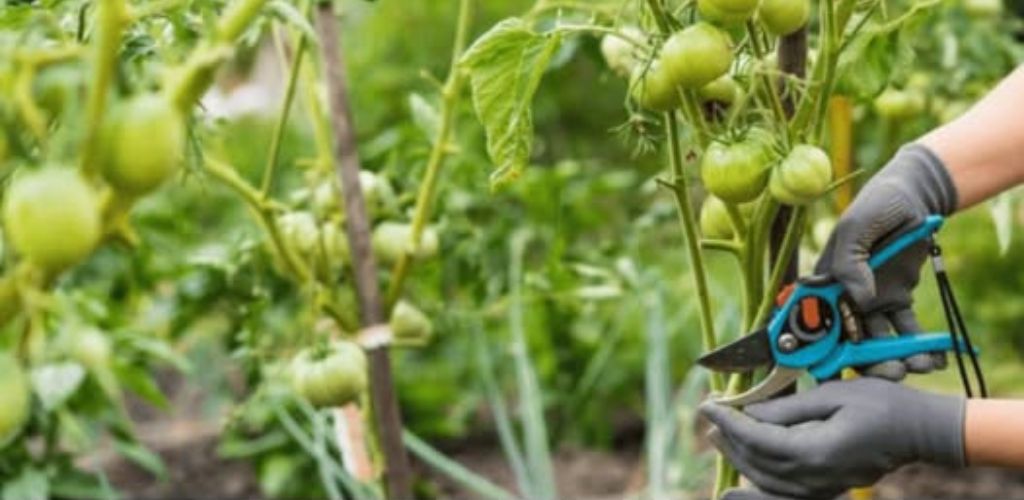
July is the month when tomatoes are in full bloom, and at this time, it’s crucial to intervene—literally with a pair of scissors. Correct pinching and leaf removal can determine whether you harvest just a few fruits… or baskets full of juicy tomatoes. Let’s talk about why and how to prune tomatoes to reward you with a truly bountiful harvest.
Why Prune Tomatoes?
Tomatoes are a plant with enormous growth potential—if left untreated, they can quickly turn into an impenetrable jungle. But this isn’t just an aesthetic problem. Overly dense bushes:
are poorly ventilated—there’s a risk of mold and rot;
they don’t allow sunlight to reach the fruit;
they invest energy in the leaves, not the tomatoes.
Proper pruning “targets” the plant: less green mass, more sweet fruit.
Step-by-Step Instructions
- Remove the lateral shoots (called “lobes” or “antlers”)
These shoots grow at an angle between the main stem and the leaf. If you don’t remove them, the plant will think a new bush should grow—instead of the more mature branches that form the fruit.
👉 Ideally, you should manually cut them when they reach 3–5 cm. - Remove the Lower Leaves
As soon as the first tomato clusters appear on the plant, you can begin carefully removing the older leaves below them. These leaves generally no longer perform photosynthetic functions, but they impede air circulation and maintain a humid microclimate—ideal for mold.
👉 Never remove all the leaves at once! Always leave a few functional leaves for the plant’s nutrition. - Check the top of the plant
For tall (indeterminate) varieties, it is advisable to leave only one or two main shoots to grow. Once it reaches a certain height, you can pinch the tip—this will stop the plant from growing and allow it to focus on ripening the fruit.
What to watch out for?
Cut in the morning or evening, not in strong sunlight.
Use clean tools or hands—this will minimize the risk of disease transmission.
Don’t remove too much at once—the plant can go into shock.
After rain, always wait for the plant to dry before cutting.
The result? A feast of tomatoes!
A well-tended tomato plant will reward you with large, evenly ripe, and tasty fruit. Instead of a tangle of shoots and leaves, you’ll have a healthy, light-filled plant with tomatoes like those in a catalog.
So grab your scissors, put on your hat, and cheers! July is the ideal time to take a step toward the biggest harvest of the season. 🍅🌞